
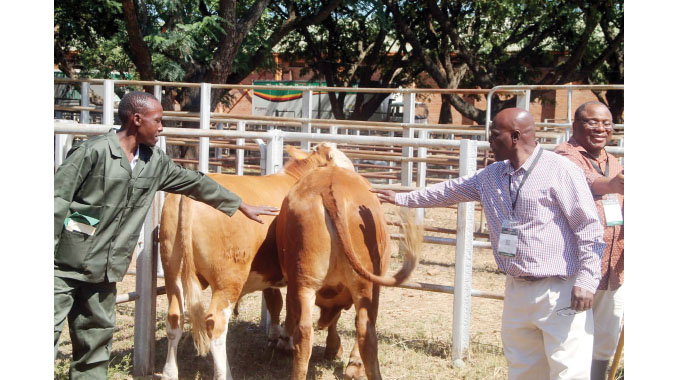
LIVESTOCK farmers from the Matabeleland region are facing challenges in accessing technical support to boost their production as there is no veterinary training-focused institution, which negatively affects the competitiveness of the leather value chain, according to the National Competitiveness Commission report.
The nearest school, which specialises in animal husbandry is the University of Zimbabwe and Mazoe Veterinary College, while institutions in Esigodini do both crop and animal husbandry with minimal impact on the region.
There is a need to establish a veterinary institute specifically in Bulawayo or surrounding areas that focuses on animal husbandry, reads the latest leather sector value chain competitiveness report for 2023 issued by the National Competitiveness Commission says.
This has to be buttressed by increased stakeholder collaboration along the leather value chain so as to unlock the sector’s vast potential to boost domestic production volumes and exports, it added.
“The institution will impact knowledge on good animal husbandry practices, which are critical for production of high-quality hides and skins, thereby enhancing competitiveness of the sector,” says the commission.
“Furthermore, Matabeleland region requires a research centre that will assist in the diagnoses of diseases and reduce the time lag taken as samples are taken to Harare.
“In addition, expedite the full operationalization of the Leather Institute of Zimbabwe. The institute should provide technical and vocational training on livestock production for farmers and processing activities to SMEs.”
Rejuvenating the leather sector is one of the key strategies for widening employment opportunities and substituting imports as espoused under the Government’s National Development Strategy (NDS).
Already, the leather industry is targeting to surpass 17 million pairs of leather footwear per annum but is being hamstrung by a myriad of factors that need urgent attention.
Although Zimbabwe is fairly ranked in terms of livestock production within the region, the commission has said the competitiveness of the subsector is being hampered by a myriad of challenges, which require more collaboration among stakeholders.
Among these are concerns over high livestock mortality rates, lack of adequate technical support, poor slaughter facilities at abattoirs, funding constraints, and security.
For instance, on livestock mortality rates, the report says. It noted that tick-borne diseases were the major cause of mortalities, contributing 55 percent of overall mortality from the sampled households.
“There is one research center situated in Matopos, where all animal samples are taken before they are dispatched to Harare. It takes an average of two weeks to get results and diagnosis from the veterinary,” reads the report.
“There are many times where farmers have lost their livestock due to such delays. Notwithstanding the fact that Zimbabwe has the lowest livestock mortality rate, there is scope for further reduction, thereby improving competitiveness,” it said.
“Furthermore, the country is failing to leverage on this and be competitive in the leather industry compared to the comparator countries.”
The report highlighted that poor slaughter facilities have a bearing on the competitiveness of the value chain.
“Abattoirs specialize in the slaughtering of sheep, cattle, and goats, and about 85-95 percent of the livestock is from communal farmers, with the remainder from commercial farmers.
“Since the bulk of hides are from communal farmers, where livestock is used for draught power and also branded using hot and cold iron, this affects hide quality, and ultimately competitiveness of the leather sector,” it said.
“Consequently, about 90 percent of the hides slaughtered are of poor quality due to poor farming methods. Prior to 2 000, commercial farmers and communal farmers contributed 50/50 and the national herd had much bigger animals producing Grade A hides and approximately 550 000 animals were slaughtered in abattoirs.”
According to the report, the owners of abattoirs who accept livestock from individuals for slaughtering, charge slaughter fees and some give part of the fifth quarter (such as offals and head) to the farmer except hides and gallstones. The abattoirs, however, believe that the farmer is paid for the hide even though it is not clearly laid out on paper.
As part of the recommendations, the has commission noted that value addition in the leather chain promotes linkages and synergies, which is crucial for diversification of exports, thereby enhancing competitiveness.
“In this regard, hides should be exported at wet stage or setting a local quota that must be satisfied before exporting,” it says.
“Currently, good quality hides are being exported thereby depriving the local market and negatively affecting the competitiveness of locally made finished leather products in regional and international markets.”
Another key recommendation is the need to develop the necessary support for livestock production and expand to more lucrative technology, capital-intensive, and high-value-adding value-adding stages of the leather value chain.
“It is, therefore, pertinent to focus on infrastructure, research and development, and technology to be competitive. This also calls for the need to implement policy reforms and improve the business operating environment in line with National Development Strategy 1.”
The leather sector occupies an important place in the Zimbabwean economy in view of its potential for higher employment, growth, and value-added exports.
Vision 2030 calls for the transformation of the country to attain middle-income status by the year 2030 and the leather sector is among the key sectors earmarked for transformation. – The Chronicle
- Latest
- Trending