


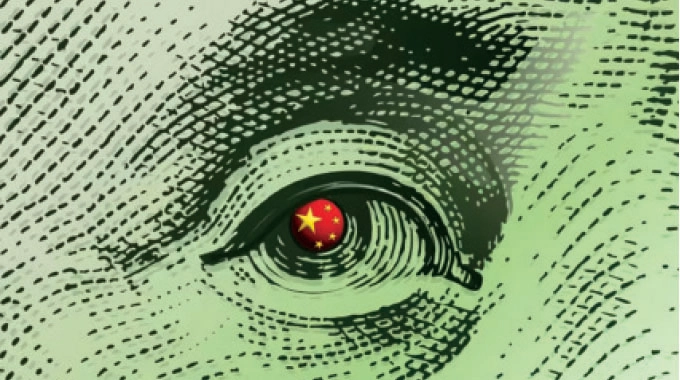
This month, Russia and China are sparking new jitters in Washington. That is primarily because of money: during a visit by Xi Jinping to Moscow recently, Vladimir Putin pledged to adopt the renminbi for “payments between Russia and countries of Asia, Africa, and Latin America”, in a bid to displace the dollar.
And this comes as Moscow is already increasingly using the renminbi for its swelling trade with China and embracing it in its central bank reserves, to reduce its exposure to “toxic” — American — assets.
Does this matter? Until recently, most western economists would have said “heck, no”. After all, it has long been assumed that the closed nature of China’s capital account is an impediment to wider use of its currency.
But right now Putin’s announcement is packing an unusually emotional punch. One reason is that concerns are afoot that this month’s US banking turmoil, inflation and looming debt ceiling battle is making dollar-based assets less attractive. “The dollar is being debased in order to fund the bank bailouts,” Peter Schiff, the libertarian economist, thundered this week, echoing a view widespread on the American right.
Meanwhile, Jim O’Neill, the former Goldman Sachs economist who launched the “Brics” tag (short for the Brazilian, Russian, Indian and Chinese bloc), published a paper last week arguing that “the dollar plays far too dominant a role in global finance”, and calling on emerging markets to cut their risks.
But the other factor sparking unease is that even before Xi’s visit to Moscow, the Saudi government announced that it will start invoicing some oil exports to China in renminbi. Separately, France just did its first liquid natural gas sale in RMB and Brazil has embraced the currency for some of its trade with China.
There is absolutely no sign that these token gestures are hurting the greenback right now. Yes, the dollar’s proportion of global reserves has sunk from 72 per cent in 1999 to 59 per cent, as central banks increasingly diversify their investment funds and discard currency pegs. And it is also true that the advent of wholesale (bank-to-bank) central bank digital currencies could theoretically accelerate this diversification by making it easier for non-American central banks to deal directly with each other in their own currencies.
But the dollar still dominates debt markets, and the volume of dollars held overseas has soared this century. And one striking, and overlooked, detail about this month’s turmoil is that the currency has retained its “near record strength vs the G10 and emerging market currencies”, as Robin Brooks, chief economist of the Institute for International Finance, recently tweeted.
Indeed, so many global investors wanted to grab the greenback during the recent crisis that the Federal Reserve launched a daily swaps programme with other central banks. “This enhanced use of dollar swap lines will, ironically, further strengthen the global dollar system and its powerful network effects,” predicts David Beckworth, a research fellow at George Mason University’s Mercatus Center.
Or to put it another way, the dollar might not deserve to win any beauty contests right now, given the fiscal problems plaguing America, but many investors still consider it the least ugly option in a very ugly world, due to that network effect and the fact that the euro and RMB capital markets are, respectively, shallow and closed.
However, before anyone concludes that this means they can completely ignore Putin’s threat, they should look at some thought-provoking research on trade invoicing published last year by the Centre for Economic Policy Research.
A decade ago, it was widely assumed that another factor underpinning the dollar was the “stickiness” of trade invoicing patterns, as Gita Gopinath, deputy head of the IMF, has noted. But the CEPR paper suggests this might now be slowly shifting — as Chinese trade has expanded in recent years, RMB use has risen too.
So much so, in fact, that it now exceeds euro-usage for trade invoicing, which is “striking, given China’s low degree of capital account openness”, the CEPR says. And it argues that “contrary to conventional wisdom, lack of capital account openness may not fully prevent the RMB from playing a stronger role as an international and reserve currency”.
After all, it notes, a US$200 billion offshore RMB market has already emerged — and the currency is being “use(d) in invoicing and settling China’s foreign trade and payments” and “a global network of clearing and payments”.
The net result, the CEPR predicts, is that a “multipolar” currency world could emerge in the coming years, of the sort that O’Neill is now calling for.
That would not be as dramatic a switch as Putin or Xi might like to see, or that Washington alarmists fear. – Financial Times