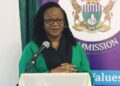

THE Permanent Secretary in the Ministry of Primary and Secondary Education, Mrs Tumisang Thabela has said the country needs at least 3 000 new schools to adequately cover the shortage and improve the learning environment for children.
The country is facing a shortage of schools, a situation that had seen some schoolchildren travelling long distances to access education.
While new schools are being constructed, population growth has created more demand for schools.
According to the 2022 national population census results, the country’s population increased to 15 million from 13 million in 2012.
In an interview, Mrs Tumisang Thabela said there is a need to address the infrastructure deficit in learning institutions due to population growth.
“We estimate that as a country we have a shortage of 3 000 schools. You will realise that from the census figures we moved from 13 million to 15 million which means we need more schools to cater for our children,” said Mrs Thabela.
She said her ministry is working with other Government departments including the Ministry of Local Government and Public Works in the construction of schools.
As part of implementing Vision 2030 anchored on the National Development Strategy 1(NDS1), the Government has approved the construction of 3 000 new schools by 2025.
There are more than 10 000 schools with a total enrolment of more than 4,6 million. The construction project will be implemented in phases next year starting with 100 and 144 model 21st-century Government primary and secondary boarding schools spread across the country.
One primary and one secondary boarding school with adequate state-of-the-art facilities will be constructed in each of the 72 districts.
The Treasury will fund the first 144 schools while public-private or joint venture arrangements will be crafted to assist in the construction of the other 3 000 schools.
Mrs Thabela said Government’s policy directs the Primary and Secondary Education Ministry to ensure primary school pupils do not travel more than 5km to access their nearest education facility.
“The distance that must be travelled by primary school learners is a maximum of 5km in terms of policy guidelines and for the secondary learner, it is 10km. We are still shy in terms of that because of the realities of the new geographies and new population in different places,” she said.
“Our ultimate goal is to see every child going to a school that is within the 5km, and when you set goals, it does not mean we can achieve them in one day since it’s a process. We continue to appeal to partners to join us as we continue to push to make sure we reduce the deficit of schools in the country.”
Mrs Thabela said through devolution funds, the Government has been able to deliver on some of the social amenities including the construction of classroom blocks in schools.
She said the Government has also secured partners for a joint venture to build more schools and rehabilitate existing ones as part of efforts to strengthen the country’s education system.
“The Government itself has continued to focus on building new schools. That is why through the development strategy on devolution almost all local authorities have been instructed to make sure that basic services are given to schools and clinics. As a ministry, we are looking for partners and money from Treasury to make sure that more schools are constructed,” said Mrs Thabela.
Speaking during the commissioning of six classroom blocks at Cowdray Park Primary School in Bulawayo last Thursday, the acting chief director in the Ministry of Local Government and Public Works, Mr Mike Dzimati said there is a need to construct high-rise classrooms to conserve land in schools.
“Most of our settlements do not have adequate schools across the country as our population keeps growing. The Government will therefore, prioritise the construction of schools in new settlements and ensuring that pupils receive good quality education, which is supported by conducive infrastructure,” he said.
“The benefits derived from constructed schools go way beyond the provision of facilities conducive to learning. They can also be used as Covid-19 centres and during times of disasters they can be used as evacuation centres.”
Chief director for Primary, Secondary and Non-Formal Education in the ministry, Mrs Olicah Kaira.
Chief director for Primary, Secondary and Non-Formal Education in the ministry, Mrs Olicah Kaira recently told the Parliamentary Portfolio Committee on Primary and Secondary Education that the Government has since availed $4,69 billion for the construction of 35 model schools in all the country’s 10 provinces.
Already, sites for the schools have been identified under the programme, 19 primaries and 16 secondary schools will be constructed with eight offering secondary school boarding facilities.
Of the 35 school sites, 25 are satellite schools already operating without proper infrastructure. – The Chronicle