



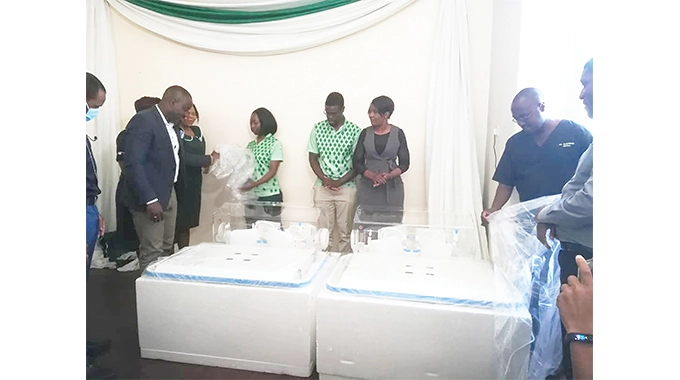
Nedbank has donated two incubators to the United Bulawayo Hospitals (UBH) as part of its social responsibility programme and the donation will go a long way in reducing neonatal deaths.
UBH services Bulawayo, Matabeleland North, Matabeleland South, Midlands and Masvingo provinces.
Often times the central hospital struggles with a high turnover of pregnant mothers from all over the region, recording an average of 20 C-sections and 30 normal deliveries daily.
The bank’s executive head of sales and business origination Heresy Herry said the bank wants to play a role in helping the country attain the sustainable development goals (SDG) of reducing child mortality.
The infant mortality rate for Zimbabwe is 34 096 deaths per 1 000 live births, a 2,65 percent decline from 2022. In 2022 the infant mortality rate stood at 35 025 deaths per 1 000 live births, a 2,58 percent decline from 2021.
Zimbabwe like the rest of the world is working on reducing the infant mortality rate to 12 deaths per 1 000 by 2030 in order to achieve the SDGs.
Mr Herry said child and maternal healthcare services still need a lot of investment from the corporate world.
He said the incubators will save lives of pre-term babies born without the ability to control body temperature.
“We are happy to be handing over these incubators as we too want to play a role in ensuring that our country meets 2030 SDGs.
“We all know that UBH has a big catchment area and that many babies are born here hence the need for lifesaving `equipment so that no pre-term baby dies, “said Mr Herry.
He said his first-born son survived because he was put in an incubator for 72 hours.
“Infant mortality is still high as we are at 35 instead of 12 per 1 000 babies.
“We hope these machines will save lives here at UBH and we promise to do our best to ensure the hospital improves its maternal and child health services,” said Mr Herry.
UBH chief executive officer Dr William Busumani said the incubators will help staff members regulate temperature for pre-term babies who are born will less developed organs.
“These will reduce neonatal deaths caused by low temperatures and when we achieve this there are fewer chances of complications to develop.
“We still need more assistance in terms of ensuring that we save the lives of our infants and mothers hence we invite Nedbank and other corporates to consider boosting us with life-saving equipment so that we meet our goals,” said Dr Busumani.
Zimbabwe has a high burden of pre-term births as about 12 percent of babies are born prematurely. – The Chronicle