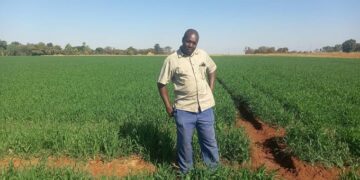



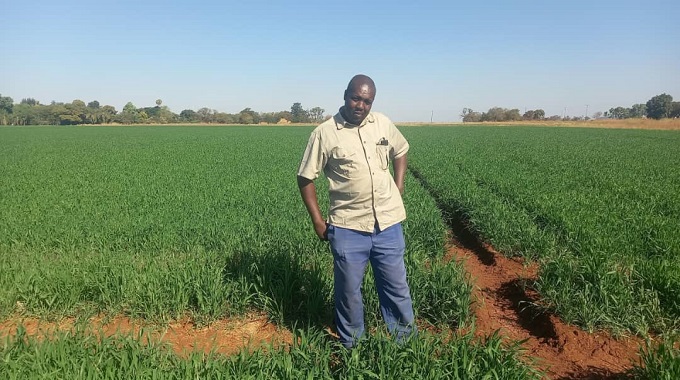
FARMERS in Midlands Province put over 10 000ha under winter wheat this season, 1 000ha above target.
Having set a winter target of 6 450 ha last year, the province also exceeded expectations and achieved a record 7 378 ha to harvest about 36 000 tonnes of wheat.
Winter wheat is mainly grown in Sherwood block and farms around Kwekwe district.
There are also some irrigation schemes in Mberengwa, Lower Gweru and Shurugwi which contribute to the provincial target.
Leading farmers such as Mr Douglas Kwande, of the fast-growing Douglas and Claris Kwande (DCK) Investments which own DCK Farm in Kwekwe have put 750ha under wheat which is germinating.
At Sherwood Park Estate in Kwekwe, Mr Daniel Burger has a flourishing crop on 280ha and is expecting to harvest an average 9t/ha.
Last year the farm averaged 8,5t/ha.
At Precabe Farm owned by the First Family, there is also over 600ha under winter wheat.
Zimbabwe produced 375 000 tonnes of wheat in 2022, against a national demand of 360 000 tonnes.
Government is targeting to increase production to 408 000 tonnes this year.
Last year’s production made Zimbabwe and Ethiopia the only two wheat-secure nations on the continent.
Locally, farmers are responding to Government’s initiatives as they ramped up preparations for the farming season.
The bulk of the planting was done under the Government guaranteed CBZ Agro-Yield programme, while the other hectares were funded by private contractors and through the Presidential Winter Wheat Scheme.
Midlands Provincial Agronomist, Mr Innocent Dzuke, said he is happy that the province had managed to surpass the 9 000 ha target. “Farmers in the Midlands province successfully put over 10 000 ha under winter wheat – a 1 000 ha more above the 9 000 ha target that had been set for this season. Having set a winter target of 6 450 ha the province last year achieved a record 7 378 ha,” he said.
“Farmers from Gokwe South managed to put 74 ha, Mberengwa 442 ha, Shurugwi 108ha, Gweru 459ha, Kwekwe 8 063ha, Zvishavane 136ha, Mvuma 753ha giving us a total of 10 035 ha under winter wheat crop.”
He said since planting has stopped, focus is now on improving yield through best management practices such as pest, disease, weed control, right amount of AN application and water management.
“These are key to improving wheat productivity because we want to achieve more tonnes from the 10 035ha,” said Mr Dzuke.
Sherwood Park Estate manager Mr Simbiso Magasa said the crop had germinated and was doing well.
“We are happy that the winter wheat crop is doing well. We planted it in time and we are now working on making sure that it grows well. We are expecting to harvest an average 9t/ha up from 8.5t/ha we achieved last year,” he said.
Mr Ronnie Chigombe, sales agronomist at Seedco said the crop at Sherwood Park Estate and other farms was looking very healthy.
“The winter wheat in most of these farms is doing well, the crop is well managed, looking very healthy and we are anticipating a very good yield and I agree with the farm manager on yield projections,” he said.
Zimbabwe is optimistic that this year’s winter wheat production will surpass last year’s yield of 375 000 tonnes following various interventions implemented by the Government and the private sector to bolster production.
In addition to local initiatives to support production, Zimbabwe received a chunk of the US$25,5 million African Development Bank (AfDB)’s fund to boost wheat and food production and avert potential food shortages.
Speaking recently during an Irrigation Stakeholders Indaba, Ministry of Lands, Agriculture, Fisheries, Water and Rural Development Permanent Secretary Dr John Basera said the country is food secure, adding that farmers should continue to work hard so that the country will be the net exporter of food.
“Our target for this year was 85 000 hectares and we have seen some recent developments and Zimbabwe is one of the two countries in Africa which is food and wheat self-sufficient together with Ethiopia. Those are the two countries which are self-sufficient in wheat,” he said.
“We want to target the export market in our region and we want to target this year and it needs to happen. We did it in 2022 where we produced 375 000 tons of wheat. It was credible and it was so sweet. We need to do it again and better. We want to surpass what we have achieved.”
Dr Basera challenged farmers this season to continue producing crops surpassing last year’s production. – The Chronicle