


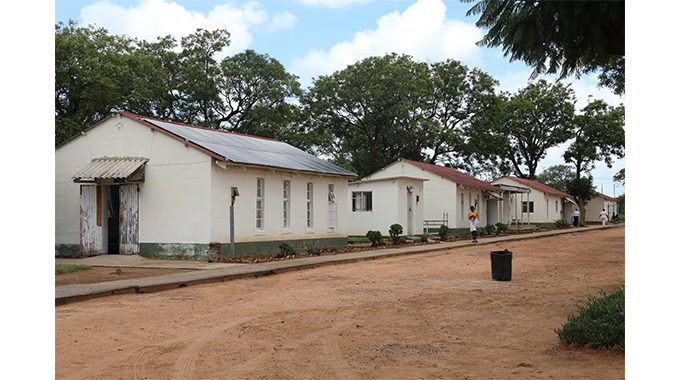
WITHIN the seemingly impenetrable walls of Khami Maximum Prison, a profound transformation is taking place. Through education and skills development, inmates are finding new paths towards personal growth, empowerment, and redemption. Far from being a place of despair, the penitentiary offers a glimmer of hope for a brighter future.
Located just 25 kilometres west of Bulawayo, the prison – which houses prisoners sentenced to a minimum of seven years to life imprisonment, according to the Officer in Charge of the correctional centre, Chief Superintended Joe Matyavira – is undoubtedly daunting and the myths and legends about life behind bars at this facility fail to capture the incredible opportunities for personal growth and empowerment available within.
The imposing prison walls and the foreboding entrance gate lend credence to the fearsome reputation of Khami Maximum Prison. However, as the saying goes, “what you see outside is not what you get inside,” Beyond the walls lies a fully-fledged society that offers a comprehensive rehabilitation programme, equipping inmates with an array of valuable skills across various sectors. Contrary to popular belief, life within Khami Maximum Prison is not a dead end; rather, it provides a transformative environment for personal reflection, growth, and empowerment.
At the heart of this transformation lies the institution’s educational programme, which is not only offered to inmates but also run by them. The programme encompasses primary education from Grade 1 to 7, secondary education from Form 1 to 4, and even tertiary education, currently offering courses in motor mechanics.
Currently, the school caters to 327 students, of whom 283 are inmates and 40 are from the local communities as part of the institution’s community assistance programme. The teaching staff, totaling 40, including the headmaster, are all serving inmates who bring their expertise to the classroom despite their past crimes.
During a visit to Khami Maximum Prison School, accompanied by Garainashe Moyo, the Zimbabwe Prisons and Correctional Services (ZPCS) Provincial spokesperson, we had the opportunity to speak with teachers, students, and the 56-year-old headmaster, Masala Mathe, who is serving an 11-year sentence for rape. Mathe succeeded Khulekani Tshidzanani, a beneficiary of Presidential Amnesty, who had achieved a remarkable 100 percent pass rate in the Ordinary Level examinations during his tenure.
One notable aspect of the educational programme is its accessibility. Inmates can attend classes free of charge, while external students pay a nominal monthly fee of US$3, which goes towards purchasing school materials. The only fee that inmates are required to pay is the examination fee to the Zimbabwe Schools Examination Council (Zimsec).
Moses Moyo, a graduate of the school who now serves as a teacher, was arrested in 2006 at the age of 22 for three counts of unlawful entry and robbery, as well as seven counts of unlawful entry. He was sentenced to 59 years in prison with 10 years suspended, resulting in an effective sentence of 33 years.
“I came here with four Ordinary Level subjects. After my incarceration, I received encouragement from prison officials to continue my education. In 2010, I supplemented my knowledge with Mathematics and Accounts, which I successfully passed.”
With his O-Level qualifications in hand, Moyo pursued studies in Accounting, Economics, and Business Studies at the High School level, achieving an impressive 10 points.
“Never in my wildest dreams did I imagine that while in prison, the same system that removed me from society would provide opportunities for me to correct my wrongs and contribute positively,” Moyo reflects. “While incarcerated, the knowledge we acquire and impart will eventually benefit society.”
Currently, Moyo teaches a class of eight internal students and 44 external students, utilising his newfound skills to make a difference.
The headmaster, Masala Mathe (56), describes his role as hectic but enjoyable, involving overseeing the teachers’ schedules and ensuring they are adequately prepared, all while attending to his own classes. Mathe commends the rehabilitation system at Khami Maximum Prison, emphasising that life behind the prison walls is not devoid of hope.
Morgan Muchandisiyi, a 36-year-old teacher at the institution, echoes the sentiments shared by his fellow educators. Serving a 19-year sentence for rape and indecent assault, he passed his O-level exams in 2017. He has nine points at A-level.
“These achievements, especially within the confines of a prison, were beyond my imagination,” Muchandisiyi admits.
While acknowledging the scary stories surrounding prisons, he affirms that there has been a significant shift from the past, where inmates were treated like animals.
“Despite being a prisoner, I am contributing to society, as we have external students here. As President Mnangagwa often says, ‘ilizwe lakhiwa ngabaninilo/nyika inovakwa nevene vayo,’ and that is precisely what Khami prison is accomplishing through this programme,” Muchandisiyi proudly states.
Dominic Nkosiyami Sibanda, a 29-year-old serving a 19-year sentence for rape and indecent assault, also emphasises the transformative impact of the prison’s rehabilitation programme. A former teacher at a school in Matabeleland North, Sibanda believes that the programme has the power to positively change the lives of serving and former inmates.
Bongani Mpofu, the Chief Correctional Officer at Khami Maximum Prison, speaks of the institution’s conviction that knowledge and skill gaps contribute to criminal behaviour.
“Once these individuals leave this place, they will be changed. We have seen remarkable examples of former inmates who have excelled in society as a result of the rehabilitation programmes offered here,” Mpofu affirms.
As these inmates strive to become valuable members of society, they prove that even behind the bars, the human spirit has the capacity to thrive and transcend its past mistakes. – The Chronicle