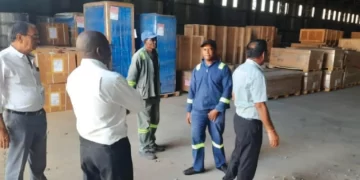



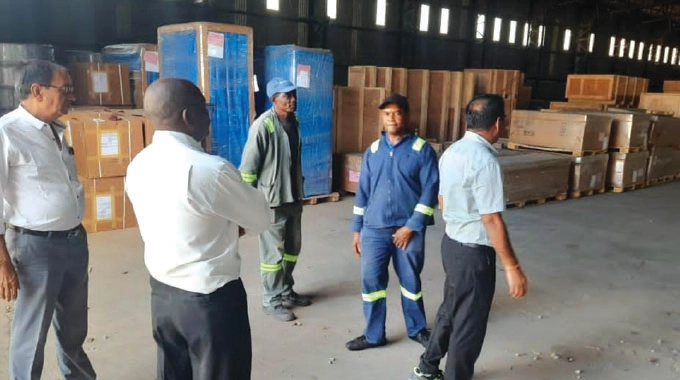
AS haulage trucks loaded with assorted machinery and equipment continue to flock to the defunct David Whitehead Textiles (DWT) Kadoma factory, former workers and residents from the gold-rich town relive the glory days of the former textile giant.
For Mr Robert Kuyerukana, the general manager of Agro Value Chain (AVC), the company which now owns the majority stake in DWT, the arrival of new state-of-the-art equipment and machinery to replace antiquated plant and machinery installed over 40 years ago signals a new dawn.
Before its closure, David Whitehead employed about 4 600 people in Kadoma Chegutu and Gweru factories. Having gone under three different judicial management processes since 2006, DWT finally got a new investor in 2019. However, the revival of the once-vibrant textile company was delayed due to pending legal issues.
Last year, President Mnangagwa, represented by Industry and Commerce Minister Dr Sekai Nzenza, presided over the ground-breaking ceremony of the revival of DWT, with US$20 million expected to be invested during the first phase.
The Kadoma spinning division, which is the genesis of textile manufacturing, is set to massively produce yarn, a key raw material for the Chegutu plant where different kinds of fabric would be produced.
Mr Kuyerukana previously worked for the company for six years from 2003 before his retrenchment. He is among thousands of workers who lost their jobs and has been finding making ends meet difficult.
The closure of the Kadoma factory also had a bearing on the town’s daily operations.
Said Mr Kuyerukana: “I can say I feel enthusiastic and overjoyed. This is the beginning of a new era as this is a very big and giant textile plant that was lying idle.
“Resuscitation means a lot to me and my colleagues. These new machines mean progress.”
Mr Kuyerukana, who expressed hope the investor would contribute towards the development of Kadoma, which now has city status, through corporate social responsibility, said the revival of DWT was made possible by the effective policies of the Second Republic.
President Mnangagwa’s Zimbabwe ‘Open For Business’ mantra has attracted many investors with the resuscitation of David Whitehead by AVC being one of the major milestones.
In a speech read on his behalf at the ground-breaking ceremony, President Mnangagwa rallied all private players to take advantage of a conducive environment that had been created by the policies of his administration to expand and thrive.
Said the President: “Our private sector should take advantage of the linkages between agriculture with other sectors of the economy, starting from energy, water, Information, Communication Technology (ICT), transport and logistics and many others.
“The manufacturing sector alone sources 60 percent of its requirements from the agriculture sector.
“Let me commend your genuine efforts towards resuscitating David Whitehead Textiles.
“You underscored the fact that once you fully revive David Whitehead Textiles, it will be churning 10 million metres of fabric annually. It will also be the sole manufacturer of fabric used in the production of military fatigues and school uniforms in Zimbabwe.”
The Government, he added, was ready to render its support to the company to bring it back to its former glory. He also exhorted AVC, which is a subsidiary of ETG Parrogate group to tap into opportunities presented by various trade agreements in which Zimbabwe is a signatory to that included SADC, COMESA and AfCFTA.
Another employee based at the Kadoma plant, Ms Yollanda Moyo (24) said she was optimistic that more youths will be employed. Similarly, youthful graduate, Ms Tariro Mulenga who is currently employed as the stores manager, said to date, the Kadoma plant had received over 90 percent of the equipment and machinery required for the completion of Phase 1.
Some of the machinery that has been received includes high-speed spindle machines.
“The received machines signal commencement of production. A lot of rehabilitation, construction and foundation works have been done,” she said.
Ms Tariro is among many youths who were skeptical and doubtful of the company’s future but her four-month stay at the textile plant has proved otherwise.
While the youthful employees got the sweet tale of David Whitehead from textbooks, street talk and other secondary sources, Mr Thomas Mangozho, the general manager of the Kadoma plant relived his experience at the company before its collapse.
He joined the company in 1983 and experienced all the highs and lows of the company.
Having risen through the ranks to his current position, Mr Mangozho said the acquisition of new machinery and stripping off of old equipment was a sign of good days ahead.
“This is bringing smiles to Kadoma, Chegutu and Mashonaland West. It is a massive project that will create employment in line with the President’s call.
“The new equipment is expected to improve our quality and way of doing work. Without the new machinery, there is no resuscitation to talk about,” he said.
Works at the Kadoma plant are at an advanced stage with workers now painting walls and fixing air conditioning systems before the installation of the machinery.
When The Herald visited the Chegutu plant on Wednesday, unexplainable happiness was written all over employees’ faces.
Over 70 former employees were recently re-hired and are working with the contractors doing the civil works at the Kadoma plant. They are optimistic about a brighter future.
Secretary for the non-managerial worker’s committee, Mr Charumbira Muremba and chairman of the managerial worker’s committee, Mr Leo Gwanzura were equally excited. Apart from being optimistic about a brighter future, they said the investor, who has not yet started reaping benefits from the plant, was paying them.
In an interview, David Whitehead’s chief operations officer, Mr Tendai Chetse said power outages had slightly affected the resuscitation process and the company had since engaged ZESA to be allocated a dedicated line. “Currently, in Chegutu we are laying foundations for the installation of new machinery that we are receiving.
“We have taken delivery of five containers with new machines and we expect more,” he said.
“We are also refurbishing our water, electricity, air and steam supply system ahead of the installation of new machinery.” Chegutu weaving plant is expected to receive 36 new looms, two boilers and other machinery within the next 30 days before the successful installation of the machinery by the end of June, Mr Chetse added. Technical director Mr Panwar who has over 40 years in the textile industry said the company had also entered into a contract with the suppliers to help install new equipment.
“The suppliers have been contracted to provide teams from India for the installation and commissioning of the machinery,” he said. “We will also have teams that will train our local workers to repair and maintain the new equipment.
“We are hoping to start installation works by May which will take at least two months to complete,” he said.
He said the training of workers to operate the machines would take three to six months. Apart from textiles, AVC has also spread its wings to cooking oil and soap manufacturing.
It has also supported the country’s Agric Recovery Plan through the contracting of sunflower which is expected to help cut the import bill. – The Herald