


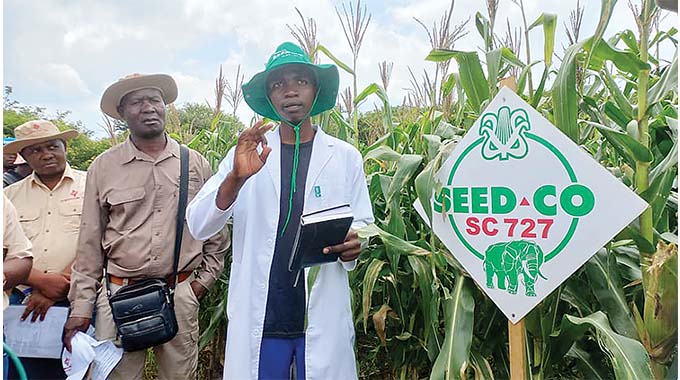
SIPHOSENKOSI Masiwa, a student at Esigodini Agricultural College, is part of a new generation of farmers who are determined to transform Zimbabwe’s agricultural sector. Her belief in the potential of agriculture to restore Zimbabwe to its former glory as the “bread basket of Africa” is contagious, and her passion for innovative and climate-smart farming techniques is inspiring.
Masiwa and her colleagues recently visited Biano Farm in Umzingwane District, where they witnessed first-hand modern technologies and climate-smart agricultural practices being practiced by Simmental breed farmer, Obert Chinhamo. The visit was part of their training in the new tertiary agriculture education curriculum, Agriculture Education for Development 5.0 (AE4D 5.0), which aims to transform the way students are trained and responds to pillar three of the Agriculture and Food Systems Transformation Strategy (AFSTS).
Masiwa explained that the curriculum has introduced new courses which were missing in the old curriculum, including research, entrepreneurship, and innovation. The visit to Biano Farm gave them valuable insights into techniques such as Pfumvudza/Intwasa, organic farming, fodder production, and silage making, all of which will come in handy in their future careers as agriculturalists.
“This is the second time that I have come here for a field day and each time I learn something new. My eyes have been opened on innovative farming and climate smart agriculture. This is crucial in our studies because our farming techniques have to adapt to climate change.
“There is still a lot that we need to do as a country in order to improve our agricultural technology and with the curriculum that we are studying and visits to places like Biano Farm our breed of agricultural graduates will manage to restore this country to its former status of being the bread basket of Africa. We have learnt new farming systems such as Pfumvudza/Intwasa, organic farming, fodder production and silage making. These are all techniques that will come in handy,” she said.
For Masiwa, the key to successful silage making is anaerobic respiration, which requires eliminating air from the process. She emphasised the importance of choosing crops with high nutritional content and those which are palatable, and the need for farmers to adapt their farming techniques to climate change.
Mfundo Ncube, another student who visited Biano Farm, was impressed by the broad use of maize crop for silage making.
“The application of fertiliser and water requirements for maize for silage making is different from the maize which is produced for eating. The spacing is also different as the forage maize is more crowded which gives more yield. As a result the soil holding forage maize has to be fed more. The SeedCo 7 series maize variety is more ideal for forage maize because of its herbage yield,” he said.
“This type of variety is a fast grower and it grows taller than other varieties. The crop has to be harvested just between tasselling and filling of grains because at that stage the maize will be having a high sugar content. This ensures that our silage gives animals the energy they need.”
Obert Chinhamo, the farmer who hosted the students, keeps a herd of about 300 Simmentals on his 80-hectare farm. He has dedicated about 50 hectares of land towards producing a variety of organic-based forage crops for silage making, which has seen him record a 100 percent conception rate this year for his animals. Chinhamo produces maize, sorghum, katambura grass, and soya beans, which he turns into silage for feeding his animals. He uses foliar fertiliser, which is organic and does not harm the soil, to promote best performance of crops.
Chinhamo emphasised the importance of equipping fellow farmers and upcoming farmers with the necessary skills and techniques to improve their production, and to turn the sector around to make the country competitive through maximised and quality production.
Government has encouraged farmers to adopt modern technologies and climate-smart agricultural practices such as silage making in order to grow the national herd and improve the quality of breeds.
Silage is one of the technologies used to preserve fodder, especially during the dry season, and it helps to preserve nutrients in fodder.
As Masiwa and Ncube demonstrate, the future of agriculture in Zimbabwe is in good hands, thanks to the innovative and climate-smart farming techniques they are being taught in the new curriculum. With a new breed of agriculturalists like them, the country can indeed restore its former glory as the “bread basket of Africa.” – The Chronicle