


ONE of the livestock production issues that I usually struggle reconciling with especially among smallholder farmers is availability of grazing land.
There is a general feeling among most smallholder livestock farmers that they no longer have adequate grazing land, largely due to expansion of human settlement as a result of exponential growth in human population over the years. However, if you go down to statistics, it shows that around 62 percent of households in Matabeleland North Province, for example do not own cattle. In fact, average ownership of cattle is around five animals per household in the same province.
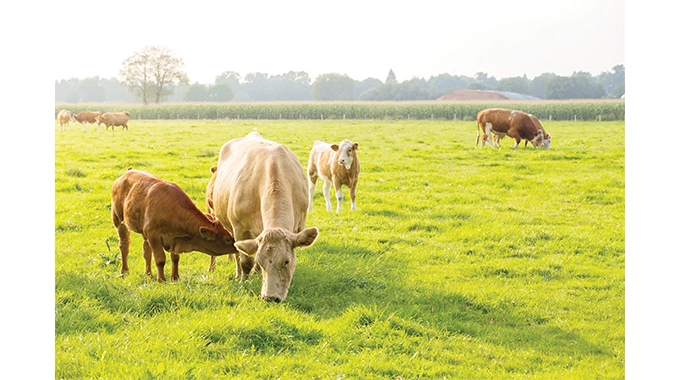
So, the question then becomes, are we really overstocked or we are simply poorly organised settlement wise? It is my submission that for a majority of our communal lands especially in the mentioned province, there is a lot of potential grazing land that is scattered in between human settlements and crop fields and these could consolidate into large rangelands.
It is our haphazard type of settlement which is making us fail to efficiently utilise the land at our disposal for cattle ranching. Maybe in the not-so-distant future the Government may have to make tough decisions and rearrange human settlements in an orderly fashion so as to open up the land for livestock production.
This may be difficult and perhaps even impossible for some settlements but quite feasible in others.
An organised settlement allows even for implementation of important principles of grazing land management in a communal set up, something very difficult in the current scenario.
The random grazing in all directions which is happening at the moment because human settlement is scattered in every direction causes depletion and degradation of the rangelands because important aspects of grazing land management such as resting some places as well as putting up conservation works to protect the rangeland does not happen.
However, if the same land was properly organised with the same animals as it holds now but with proper principles of grazing land management applied because the settlement pattern allows for that, it is my submission that the available grazing land in most areas will carry the current livestock units comfortably.
The amount of potential grazing land lost to abandoned crop fields and in between scattered human settlement, consolidated into one piece of land, becomes substantial in size. Prioritisation of human settlement reorganisation is a national conversation which we should have sooner than latter so that we are able to free more land for livestock production. Otherwise as inelastic as the land surely is, something will eventually give in production wise. We will have large expanses of human settlement with very little or no livestock at all in the long run as disorganised human settlement squeezes rangelands into extinction. Alternatively, we will see new production paradigms that focuses on livestock species that require less grazing land, such as goats and sheep. Goats are predominantly browsers which means they consume more of tree leaves and less of grass.
This makes them survive better in areas that have less grazing space. Signs are already there of a number of livestock farmers migrating from beef production into small stock production. I have met small stock farmers with as many as 300 goats in a communal set up.
You can raise such large numbers of small stock in a communal set up without anyone raising an issue about overstocking but with cattle production once your numbers approach a hundred the community will be up in arms with you for depleting their grazing land!
My view therefore, is that if we need to continue cattle ranching in communal areas we need to have this national conversation about human settlement reorganisation or else we will witness a drastic decline in smallholder livestock production numbers.
That could be the beginning of death for the beef production value chain which is currently largely sustained by smallholder farmers who hold close to 80 percent of the national herd. Uyabonga umntaka MaKhumalo.
Mhlupheki Dube is a livestock specialist and farmer. He writes in his own capacity. Feedback [email protected]/ cell 0772851275 – Sunday News