


Montreux, Switzerland – Charmed by Zimbabwe’s local resource mobilisation and deployment of health services, a not-for-profit international health financing behemoth has stepped up and offered partnership to finance inherent gaps in the country’s health services.
Zimbabwe has of late gotten international commendation for the manner in which it is handling its healthcare particularly as the world reels from Covid-19 effects.
Informed by President Mnangagwa’s “Nyika inovakwa nevene vayo” philosophy, Government has squeezed to meet its healthcare obligation.
Now, Gavi, a global Vaccine Alliance bringing together the public and private sector with the view of saving lives by increasing equitable and sustainable use of vaccines, has asked Government to draw up its finance request for partnership. The international behemoth, with operations in more than 73 countries has already identified human resource capacitation and building medical cold chains in Zimbabwe.
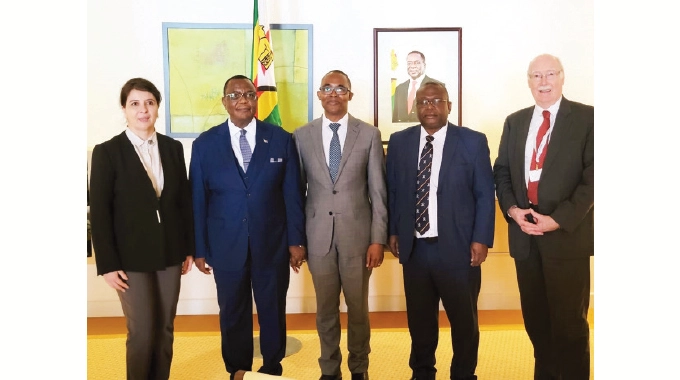
Speaking after meeting Vice President and Minister of Health and Child Care Dr Constantino Chiwenga on the sidelines of the 5th edition of the Global Ministerial Summit, Gavi managing director of Country Programmes Mr Thabani Maphosa said the organisation has been impressed by Government’s consistent healthcare financing commitment.
“I had an opportunity to discuss with the Vice President the state of the health system in Zimbabwe and the immunisation programme coming out of Covid-19, the type of lessons that have been learnt and how we can come together to help the country to strengthen its health system,” said Mr Maphosa.
“Zimbabwe has done very well on Covid-19, it is very clear that Covid-19 has been kept at bay in the country in the context of where the whole world had to fight the pandemic, Zimbabwe had minimal death cases, yes, they were (deaths) there, but I think when you look at relative to its neighbour South Africa for example, it did very well in containing.
“I think they are other programmes in immunisation, Zimbabwe has always had a strong immunisation programme.
“But that programme has suffered in the recent past with the pandemic specifically because attention and resources had to be diverted to fight Covid-19.
“To keep the pre Covid-19 momentum we need to think about the health workforce at a local level starting with community health workers, but going up to the hospitals, the district hospitals.
“The Vice President spoke about the Lupane model hospital in terms of its role and how they need to be staffed.
“We have a set of resources that are ready to be availed to the Zimbabwean Government and they need to point us where they need to go.
“But, with the Vice President some of the things we discussed specifically was the opportunity to actually strengthen their cold chain and also to strengthen the health workforce and to provide vaccines in a timely manner.
“As I said also, Zimbabwe has actually met its commitments as far as co-financing for vaccines, they have always paid on time, and it is something that we appreciate.
“So, when we put our portion of the money we are actually putting in and contributing to a country and a government that is also putting in its own money,” said Mr Maphosa.
Meanwhile, the summit opened yesterday with pivotal discussions and contributions provided by international, leading experts in the field of patient safety ahead of today’s meeting of the political leadership.
At the experts’ meeting Zimbabwe was led by Chief Director in the Ministry of Health and Child Care Dr Israel Dube told The Herald that Zimbabwe is already implementing most of the things recommended for implementation.
“We also have patients who will be managed coming from home, things to do with either palliative care, home based care, we also want those patients who are outside of the mainstream health institutions also to have the safety aspect and this is what this whole conference is about,” said Dr Dube.
“Increasing patient safety, increasing the safety on the equipment used in hospitals and also all the drugs which we use to make sure we do not cause harm to the patients.
“In the past people may have been aware of things like either instruments being left in a patient during operation or amputation of the wrong side, or a wrong procedure on the patient.
“One of the key to reducing surgical errors is the use of what is called the surgical checklist which we have been using in Zimbabwe.
“Most of the strategies which are used to increase patient safety as Zimbabwe we are actually doing most of them but there is always room for improvement.
“Usually with the collaboration we are doing with other countries including WHO (World Health Organisation) then it means we can actually maximise patient safety or even take it to a higher level than what we were doing,” said Dr Dube. – The Herald