


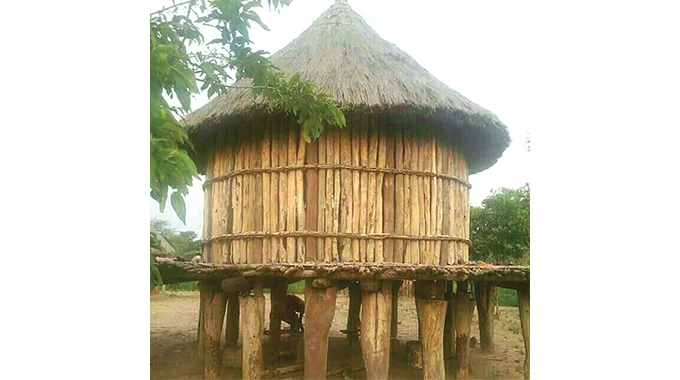
BINGA is a unique district, not only because of its geographical location in the country, but because of an exclusive culture and its people, as well as distinct structures. There are practices and activities that make Binga, located north west of the country in Matabeleland North, very different from other communities. As one enters the district, one is welcomed by the sight of elderly women with a tobacco smoking pipe known as ndombola in the Tonga language. Ceremonies are spiced up by unique music and dances such as ngoma buntibe, where instruments rarely found in other communities are used. There is a distinct feature that is only characteristic of the BaTonga people – the ngazi – an elevated hut that can be equated to a double storey building in other civilisations. A ngazi is a hut that has many uses, including providing accommodation and security. The hut is made up of pole and dagga. On the ground are poles to balance the hut that is elevated approximately two metres above the ground. One uses a ladder to climb and enter the ngazi. Most families make the bottom part of it a pen to secure domestic animals. Each homestead has at least one ngazi and another structure, known as ntombo or tungu, almost similar to a ngazi and this is used to store food or dry farm produce. To BaTonga people, having a ngazi also defines social status as many homesteads that have the structure are viewed as stable and developed, although some are abandoning the structure opting for modern houses. Chief Siansali of Binga said the ngazi is a multi-purpose structure which above all, defines social status. “A ngazi has to be there at any homestead to signify that there is a man who is also a farmer. Having it shows that one is a fully grown and responsible man,” said Cheif Siansali. He said the structure is a multi-purpose facility providing a shade during the day to protect people from the sun and rains. People can also sit underneath the ngazi shed while drinking beer. “It’s also for security reasons as it protects people from attacks by wild animals and also from mosquitoes because the insects are a lesser problem on higher structures,” said Chief Siansali. A villager, Mayas Mudenda, said the ngazi is a form of accommodation which BaTonga people use especially in areas that have wild animals. only fnas rebecca_volpetti “A ngazi is very important for security of both people and livestock like goats and sheep which are penned under the hut to prevent attack by predators at night,” said Mr Mudenda. He said BaTonga people use a ladder to climb the ngazi. “Once inside, especially at night, one pulls up the ladder so that when an enemy comes they won’t be able to reach you. So the ngazi was used as a security structure during times of war. Wild animals would also not attack people because of the height,” he said. Weapons and important artefacts were also kept in a ngazi. Because of the elevated structure, the ngazi also provides a cooler atmosphere at night compared to ordinary huts, Chronicle learnt. Mr Ephraim Dube from Mudabala area along the Zambezi River said a ngazi has numerous uses. “We have a ngazi and a ntombi, these are similar in structure but serve different purposes. A ngazi is a bedroom but under it there is a pen for goats and sheep to protect them from ravaging animals like hyenas. These are local double storey buildings and show early civilisation for Binga. “A ntombo is used for storage of food and beautifying the homestead and to store food and farm produce before being separated from chaff,” he said. – The Chronicle
- Latest
- Trending