


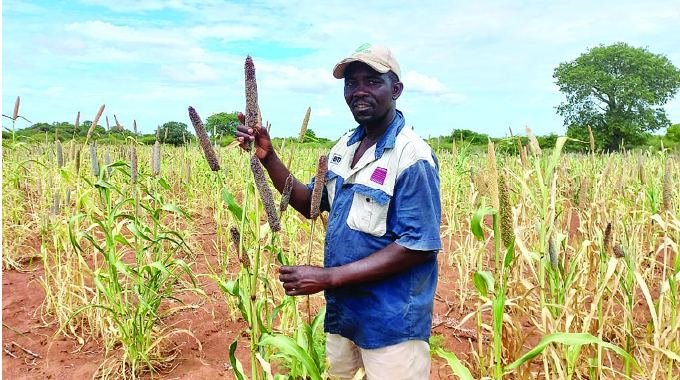
TRADITIONAL grain farmer, Mr Themba Ndlela and his wife Ms Tsepang Ncube from Gwanda District have started harvesting pearl millet from their one and a half hectare field after a successful farming season.
The couple took heed of Government’s call for farmers to adopt traditional grains.
Although their area received low rains, they are looking forward to harvesting at least one and half tonnes of pearl millet.
Their area last received good rains at the end of November. This is their fifth year of growing pearl millet and they have been recording good harvests regardless of the poor rainfall patterns.
The couple which relies on farming for a living has a herd of 87 cross boer goats that they managed to grow using the money they get from selling their traditional grains.
They also planted maize crop in another field but they do not expect to harvest anything as the crop is a complete write off.
By the end December, farmers nationally had planted 134 221 hectares of traditional grains, more than triple the 37 428 hectares they had planted by that time in 2021.
Under the Presidential Input Scheme (Pfumvudza/Intwasa) this season, the Government is targeting 312 890 hectares under traditional grains such as sorghum and pearl millet with a projected combined yield of 318 383 tonnes. This is reflected in the Pfumvudza/Intwasa programme where farmers in areas unsuitable or marginal for maize have traditional grain seed packs instead to boost the chances of a decent harvest.
In the wetter areas, farmers are advised to plant one plot of traditional grain.
Maize has been a popular crop, with many farmers producing it at commercial level, while others in the drier parts of the country have also continued to try their luck despite low yields and the risk of a write-off. But traditional crops such as sorghum, pearl millet and rapoko are slowly becoming popular as people are becoming aware of their high nutritional value and improvement in technology which has seen the introduction of machinery for processing them.
Farmers in dry areas have been urged to grow traditional grains in order to increase the chances of harvest.
Mr Ndlela said he has never gone wrong with farming traditional grains.
“This is my fifth year growing traditional grains and I have been recording good harvests. I have been harvesting an average of two tonnes of traditional grains from my field. This year I’m expecting to harvest one tonne and a half or more because of the extreme dry conditions. This year the rains have been very poor; we last received significant rains end of November but my crop has managed to withstand the harsh weather.
“I had also planted maize in another field but it didn’t do well. The traditional grains which I grow in my field have been my source of livelihood for the past years. I have also managed to grow my goat herd using proceeds I earn from selling my harvest. I usually sell traditional grains to community members. Some buy traditional grains in exchange for small livestock such as goats,” he said.
Mr Ndlela said he sells a 20 litre bucket of pearl millet for R150.
His wife, Ms Ncube said they planted their traditional grains beginning of November. She said they planted short variety seed which ripens after three months.
Ms Ncube said they used goat manure to ensure that their crop performs well.
Qualia birds which are a common menace to traditional grain farmers threatened to affect their produce but Ms Ncube said they were able to devise a mechanism to keep the birds away.
“When we have crops in the fields, we make it a point that we wake up in the morning to keep watch of birds. My husband made a web of strings above the field and attached some 500 ml empty water bottles filled with small stones. These are all joined to a string which is tied to a tree. When birds come, we pull that string which then shakes those bottles and the stones make noise which scares off the birds. This is easier than trying to chase the birds by moving around the fields as it’s difficult to contain them,” she said.
Ms Ncube said through their farming activities they have managed to fend for their five children.
Acting provincial director of agricultural rural development and advisory services for Matabeleland South, Mr Mkhunjulelwa Ndlovu said in region 4A and some parts of 4B, the maize crop usually performs well but some parts of 4B, 5A and 5B were ideal for traditional grains because they were dry areas. He said pearl millet was ideal for region 5B which were the severely dry areas while sorghum was ideal for 4B and 5A which are the moderately dry areas.
Mr Ndlovu said pearl millet has high chances of surviving in dry conditions when compared to sorghum.
“Farmers who embraced the pronouncement by Government of growing traditional grains will be guaranteed of a good harvest. Most farmers who focused more on maize are in trouble as the first and second crop are a complete write off in most parts of the province; pearl millet is the most drought tolerant crop.
“Adoption of traditional grains by farmers is a process but we are making progress. This year the traditional grains have surpassed maize a bit compared to the past where we had more maize. We have seen over the years that maize production in most parts of the province has resulted in great losses for farmers. Farmers have to think more of food security when conducting their farming activities,” Mr Ndlovu said. –