

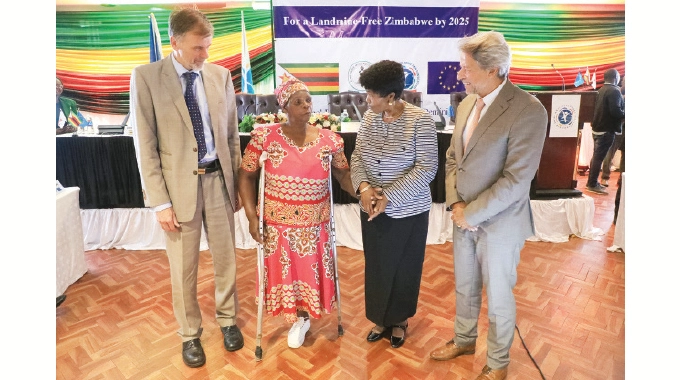
The Government is in the process of amending the War Victims Compensation Act to include landmine victims as the country gains global recognition in landmine clearance towards a landmine free Zimbabwe by 2025.
Defence and War Veterans Affairs Minister Oppah Muchinguri-Kashiri yesterday said the move was aimed at uplifting the lives of landmine victims most of whom had become economically inactive because of injuries.
Speaking during the closure of a stakeholders dialogue on humanitarian de-mining for a mine-free Zimbabwe in Harare yesterday, which followed a visit to Rushinga and Nyamapanda minefields, Minister Muchinguri said Government would continue to treasure the plight of victims and uplift their livelihoods.
’’During the course of this meeting some mine victims and survivors aptly testified to the danger posed by anti-personnel landmines not only to life and limb but also to the victims and communities potential for economic development,’’ she said.
“The mines indeed have a negative impact of impoverishing their victims by inhibiting their individual and communal productive capacity.
“It only takes adequate moral and material support from their families and other well-wishers to successfully restore the productive and self-reliance capacity of mine victims.
“In this regard we are in the process of amending the War Victims Compensation Act to include landmines victims to support them.’’
She said the socio economic benefits being brought by mine action programmes were in line with the national visions.
The presence of landmines, she said, was synonymous with war zones.
“The lives of innocent civilians are always endangered by the mines. As such, they are always gripped by the fear of freely moving around for fear of falling victims to the indiscriminate weapons,” she said.
Traditional leaders also raised their concerns on landmines saying their communities had been denied development by the remnants of war.
“We are very thankful to the authorities for providing us with mine risk education. For many years, we were afraid to leave our houses and cultivate our land as we were unsure if it was contaminated. Now, knowledge will reduce the risks of accidents in our community,” said Chief Ngwenyeni, Mr Kennias Mukachana of Chiredzi South.
A landmine victim, who now walks with an assistive device, Mr Hlengiwe Mudzikiti of Dumisa village in Chiredzi South said: “It means so much to me that I am now able to be independent and carry out basic daily activities.
“It relieves the burden on my family and I do not feel helpless anymore.”
During the dialogue, a number of regional and global humanitarian organisations involved in landmines and diplomats reiterated their pledge to work with Zimbabwe in a bid to achieve a landmine free country in two years’ time.
Ambassador of the European Union to the Republic of Zimbabwe, Mr Jobst von Kirchmann said the job Zimbabwe has done in mine clearance was second to none.
“Zimbabwe has done an extremely commendable work for its affected communities. The European Union stands ready to work with Zimbabwe uin its landmine clearance endevours,’’ he said.
African Union (AU), director Governance and Conflict Prevention Political Affairs, Peace and Security Department, Ms Patience Zanelie Chiradza said AU would stand by Zimbabwe in the quest for a landmine free Zimbabwe.
“I congratulate Zimbabwe for the resilience she has shown and continues to show in implementing her obligations, as the AU we shall do all it takes to support efforts of Zimbabwe.Anti-personnel landmines are one category of weapons that are internationally banned under the 1997 Mine Ban Convention, to which Zimbabwe is party.
“Zimbabwe has, over the years remained committed to meeting its obligations under the Treaty, and is now working towards clearing all contaminated areas by 2025, in line with Article 5 of the Convention,” she said.
She reiterated Zimbabwe has developed a world-class strategy that the AU is proud of, to achieve landmine clearance target.
German Ambassador to Zimbabwe Mr Udo Volz concurred that progress made by Zimbabwe to address the landmine threat was very commendable.
‘’I would like to take this opportunity to thank the Government of Zimbabwe and ZIMAC, the African Union and the Implementation Support Unit for organising and hosting this important dialogue.’’
“For those unfamiliar with the Convention and the work of the Committee on Enhancement of Cooperation and Assistance in Geneva, our efforts are geared to the full implementation of Article 6 of the Convention.
As the name of the Committee indicates, the goal is to support State Parties in their implementation through improving cooperation and assistance. And this is also a core commitment of the Convention.’’ – The Herald