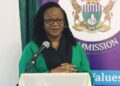

RECENTLY installed Chief Manguba says he wants to be a developmental leader that will help his area to complement the rest of the country in attaining Vision 2030 of an upper middle-income economy.
The soft spoken traditional leader believes this can be achieved by being an approachable chief.
He said he will listen to ideas from the people and coordinate them to spearhead Government programmes.
Born Mr Morning Moyo (62), Chief Manguba was installed last week during a ceremony held at Phakama High School in Bulilima, Matabeleland South Province, where Local Government and Public Works Minister July Moyo presided.
The Manguba chieftaincy was stopped in 1911 by the colonial regime.
Bulilima is a vast district with 22 wards and has five chiefs assisted by 16 headmen.
The area under the jurisdiction of Chief Manguba is Gala (Ward 6), Huwana (Ward 8) and part of Ward 5 covering Bhilingoma and Matjinge villages.
The area has six primary schools which are Huwana, Ndutshwa, Ntoli, Gala, Kungubo, Sinotsi, Gampu and Manguba. The ward is serviced by Maqhekeni, Phakama and Zenzele secondary schools.
It has Huwana and Gambo clinics which both refer patients to Lady Stanley Rural Hospital.
Chief Manguba was the headman of the area which used to fall under Chief Gampu but administratively Chief Gampu reports to Tsholotsho District in Matabeleland North Province.
Chief Manguba says he has three developmental priorities that he wants to tackle in his area; food security, health and schools.
“The concern that I have with the schools is the low pass rates that were recorded at all the schools in my area. I would like to build a house for a doctor so that he or she can have a place to live and attend to the patients in the village.
“There should be more clinics built so that people cut the distance they travel to Lady Stanley Rural Hospital which is about 5km, which is far.
“Under food security, I would want people to grow their own food rather than wait for handouts. I will be strengthening Government programmes such as Intwasa/Pfumvudza,” said Chief Manguba.
Chief Manguba was born on July 20, 1960, at the Manguba homestead and learnt at Manguba Primary School, before attending Gala primary and Dombodema secondary.
In 1978, during the height of the country’s liberation struggle Chief Manguba travelled to Zambia through Botswana to join the war. He arrived at Nampundu Zipra Transit Camp and went for education at Jason Ziyaphapha Moyo Camp.
After independence, Chief Manguba returned to his home area and sat for the Zimbabwe Junior Certificate (ZJC) before teaching at Manguba Primary School.
In 1983 he travelled to South Africa for work and was employed at various hotels as a chef and waiter. The chief lived in the neighbouring country until 2001 when he returned to Zimbabwe following the death of his father Mavukuvuku, who was the headman of the area.
In 2002 Chief Manguba took over the headmanship.
“The reason my name is Morning is that I was born in the morning on 20 July 1960. My parents decided to name me that, Indosakusa in isiNdebele, because it was at the break of dawn,” said Chief Manguba.
He said he loves farming and is an advocate for peace.
“I love farming, that’s what I’m doing now and I love eating traditional food such as Amabele, Inyawuthi and the like. I love listening to gospel music, contrary to the belief that people from the area only love Rhumba music. Rhumba is good music but I think it’s for the young people,” said Chief Manguba.
“All I want is for people to live in peace in my area. This will help the area fully realise its developmental potential. Without peace, an area will not develop. Also, I want people from the area like me to develop in line with the Government’s philosophy that says Ilizwe lakhiwa ngabaninilo.”
Chief Manguba is married to Ntombi Moyo and has four children, Nokwazi, Brian, Mcebisi (all in South Africa and from a previous marriage) and Sandi who lives with him at the Manguba homestead alongside his grandchild.
Chief Manguba’s years of working with the people of the area as the headman has brought him closer to them, he says.
“All people have their own cultures, and what is important is that I become a chief that listens to his people, regardless of tribe or nationality. When there is a need for advice to give or direction to give I do so. If there are good things, we see from other places I’m open for us to sit down and speak about them and perhaps adopt them,” said Chief Manguba.
“If you don’t listen to the people, how will you know their needs? If I knew what they need, I have the powers and mandate from the Constitution and Traditional Leaders Act to bring about that change.”
Local Government and Public Works Minister July Moyo presents the Constitution of Zimbabwe to the newly installed Chief Manguba while president of the Chiefs Council Chief Charumbira, his deputy Chief Mtshana Khumalo and other chiefs witness the occasion
Chief Manguba said re-establishment of the chieftaincy was a welcome development as his people now have representation.
“We have been at this from 2013 asking to have our own chief. In 2015, we approached Chief Gampu pointing out our dissatisfaction because we didn’t feel represented as a people from Matabeleland South. Headman Muyemwa played a crucial role and we must thank him because he agreed that I become the Chief in the area,” said Chief Manguba.
He thanked President Mnangagwa for listening to their pleas.
“The Second Republic really recognised and listened to the cries of the people from this area as evidenced by me being installed chief.
Also, President Mnangagwa has to be thanked on behalf of the family,” said Chief Manguba.
The Manguba people are of the BaKalanga tribe. Chief Manguba’s great-grandfather, Ningwale had three sons and these were Jonas, Madabani and Bulayu.
Jonas became the first headman and when he passed on in 1962, Jeremiah Luhulo, his son, succeeded as caretaker.
Jeremiah was appointed headman in 1965 after it was realised that the rightful heir to the throne who was the eldest surviving son of the last incumbent, Thomas Mtsamayi was in Johannesburg.
After the death of Thomas in 1989, Mavukuvuku Moses assumed the headmanship and was installed in 1994. Mavukuvuku was then succeeded after his death in 2001 by Morning Moyo. – The Chronicle