


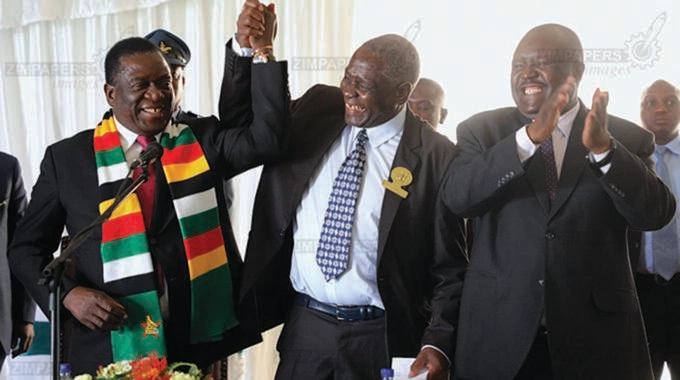
ON Thursday, the Unity Accord turns 35. If it were human, this is the stage when elders would say it has come of age.
For most Zimbabweans, this is when Black Umfolosi’s timeless sound track “Unity” rings the loudest.
The significance of the day is at the heart of peace and stability, which have become part of Zimbabwe’s identity for decades
A dive into history would suffice to explain the origins, philosophy and ideas that underpin this important national day.
On December 22, 1987, the then ZANU leader and Prime Minister Robert Mugabe and ZAPU President Joshua Nkomo entered into a pact for the two dominant indigenous political parties to combine forces, morphing into a singular party — ZANU PF.
Then Prime Minister Mugabe accepted the offer to become the country’s Executive President, with Joshua Nkomo being the Vice President.
In the run-up to the agreement, there had been difficult moments, punctuated by tribal conflict, as the country organised itself into the post-independence space.
Although the day has been religiously commemorated, the Second Republic, under President Mnangagwa, has given fresh impetus to it by deciding to solve outstanding tensions from the past.
Soon after assuming his role as the country’s first citizen, President Mnangagwa called for open and frank conversations around difficult moments in history, including Gukurahundi.
Since conversations on bringing finality to the Gukurahundi issue began in 2018, progress has been recorded.
In seeking a solution, the Government has decided to adopt indigenous conflict-resolution mechanisms, with traditional leaders playing a key role.
Explaining the reasoning behind this approach at the launch of a manual that will guide the consultative process, in October this year, President Mnangagwa said local differences should be solved through home-grown solutions.
“It is, indeed, a defining occasion for the whole country as it is an apt demonstration that under my watch, the Second Republic is determined to resolve whatever conflict between us internally and without interference from external forces,” said President Mnangagwa.
His Excellency said the expected topmost outcome from the process is closure.
“As President, I took a bold and yet decisive initiative for the nation to open up, discuss and, more importantly, bring to finality this Gukurahundi issue,” he said.
The manual does not only give a guideline to aggregate community views on issues, but also grants traditional leaders the role to lead the process so that ideas are exchanged at community level.
According to the manual, chiefs in Matabeleland felt the time is now ripe for open discourse around Gukurahundi.
“After an invitation from the National Council of Chiefs, the chiefs from Matabeleland North and Matabeleland South have deliberated on the issue of Gukurahundi, which has been haunting our people and souls of this part of the region, hence it has been resolved and seen fit that it was high time that the people of Matabeleland say what is in their hearts,” the manual reads.
The inclusion of chiefs speaks to the 2008 African Union Transitional Justice Framework, which locates traditional leaders at the centre of all transitional justice efforts.
To demonstrate how serious and sincere the current administration is treating the exercise, each time there is need for engagement, President Mnangagwa travels to the Matabeleland region.
Although chiefs are central to the process, civic society has not been left out.
The door has been opened to all who may be interested in exchanging ideas on finding a forward-looking solution.
Even activists like Ms Jennifer Williams, who leads Women of Zimbabwe Arise (WOZA) and the Matabeleland Collective, has thrown her weight behind the process.
Ms Williams was quoted in our sister paper, The Chronicle, saying she is in full agreement with the methodology being applied by the Government in handling Gukurahundi.
“So, now we feel that when we adopt a domestic approach like this one . . . it is more relevant to the community that you are dealing with. So, we are happy that the Government and His Excellency have seen the wisdom of that. And now it will become a reality that local communities are themselves the leaders of their own healing,” she said.
Currently, the process of gathering ideas and listening to communities is ongoing, through a panel of traditionalists, pastors, counsellors, women, men and youths.
Once it is concluded, chiefs will make recommendations to Government on what the next steps may be.
However, it is now clear that there are likely to be exhumations, reburials and compensation.
Information, Publicity and Broadcasting Services Minister Monica Mutsvangwa told journalists after the launch of the manual that there would be due regard to traditional sensitivities around the process.
“Concerning the issue of exhumations and memorials, traditional leaders will work with affected families for verification purposes, as well as identifying tradition and customary implications to rituals and ceremonies to appease the dead,” said Minister Mutsvangwa.
Compensation for victims, Minister Mutsvangwa said, would be treated on a case-by-case basis.
Some results of the process are already showing.
Early this year, President Mnangagwa directed the Ministry of Home Affairs and Cultural Heritage to adopt a waiver for those who may not have all the requirements to get national identity documents.
This has the net effect of allowing people in affected areas to be part of the country’s administrative mainstream, participating in processes such as voting, opening bank accounts and enrolling for school.
While commemorating Unity Day, it is important to reflect on progress made in pursuing transitional justice by the Second Republic under President Mnangagwa.
As Black Umfolosi’s familiar Unity Day chorus rings through our ears, this could be a time to sing along to the tune, signifying a country seeking a clean entry into the future by talking about difficult moments of the past. All these are said to be signs of a maturing society. – Sunday Mail