


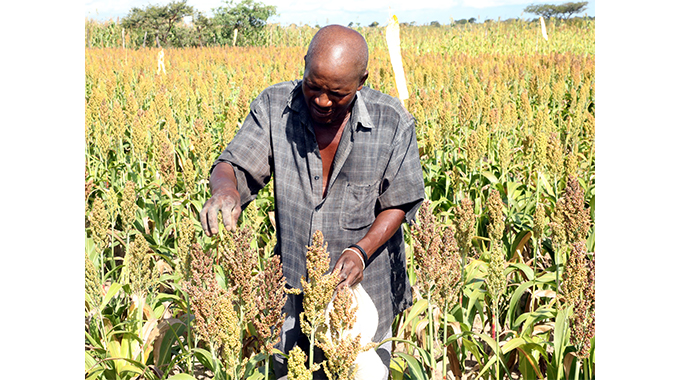
Quelea birds are wreaking havoc at Heany Junction in Umguza District, Matabeleland North Province, with farmers counting their losses as the birds have destroyed most of the sorghum and sunflower crop.
The red-billed quelea is the most damaging pest of wheat, sorghum and millet in Zimbabwe.
Quelea is a small passerine bird of the weaver family Ploceidae, native to sub-Saharan Africa. The southern race of quelea breeds in arid areas that are predominantly border areas in Zimbabwe forming part of Parks and Wildlife Estates with neighbouring countries.
Red-billed quelea prefer feeding on seeds of annual grasses but when no longer available, small grain crops become the next option thus becoming a huge threat.
Villagers from Heany Junction are at a loss of ideas as to how to control or deter the birds from eating up what is remaining of their sorghum and sunflower crops.
Scarecrows are put up as a deterrent, but it seems the birds have realised that these are just lifeless contraptions that will not harm them.
The villagers also use rudimentary methods to fight the Quelea birds. They wake up early in the morning and clap their hands loudly while running up and down the field chasing the birds away. The villagers repeat this process later in the afternoon.
Farmers who spoke to Chronicle said the birds have destroyed most of the sorghum and sunflower crop and appealed to anyone who has a solution that would help them fight the scourge to assist.
The villagers receive inputs from Government such as seed for sorghum, millet, maize and sunflower through their Agritex Officer for Ward 2, Mrs Boitumelelo Ngwenya.
At Village 7B, Mr Jonathan Kazingizi was in his field, counting his losses, as the Quelea birds had eaten more than three-quarters of his crop.
At the property that he and his wife, Ms Flatah Moyo, run is maize, sorghum and beans that are ready for harvesting.
Mr Kazingizi said he has tried in vain to chase the birds away and even the makeshift scarecrows are not doing their “job”.
“My wife and I set up these makeshift scarecrows and the birds aren’t deterred. The birds come like a swarm of bees and in no time they would have eaten the tassels of the sorghum. We are at a loss of ideas as to how we can fight this scourge,” said Mr Kazingizi.
He said he and his wife wake up as early as 4AM to monitor the fields and chase away the birds.
“These birds started their raids in January and as soon as the tassels were getting ripe, the birds came and ate them. We planted these in October thinking it’s a bumper harvest this year due to the good rains.
“The only way we can chase them away is by clapping while running up and down the field until around 7AM and at around 4PM it’s the same routine,” said Mr Kazingizi.
He said this season, he has accepted that there will be no significant harvest.
“As I look at my plot, I’m sad. I see that I have lost most of my harvest to these birds, and I don’t think I will get anything from this plot.
I was expecting more than a tonne from this field, but now I don’t think I will get anything,” said Mr Kazingizi.
His neighbour, Mr Hillary Goto, said he had been battling the birds, alongside his wife Mrs Ophia Goto for years.
The couple’s plot has sunflower, groundnuts, maize and sorghum and the battle is not only with Quelea birds. They also have running battles with other animals threatening their crops.
“When we plant, izikhwehle (Crested francolin) give us a torrid time and we have to be on high alert. When the crops are about to ripen, the Quelea birds attack the sorghum and sunflower and the crows also come and dig up the ripening groundnuts. It’s a constant battle,” said Mr Goto.
He said he wanted to buy a hailer as he believes this will drive the Quelea birds away.
“I think a hailer is the way to go.
I want to know where people in the city who have those hailers that advertise pest repellents buy them. I once went into Bulawayo and asked them and they didn’t want to tell me. I think if I have that I can just switch it on full blast and it will make enough noise to chase away the birds,” said Mr Goto.
Other farmers such as Mrs Emmie Ndlovu have planted sorghum, but it’s still in its infancy. Mrs Ndlovu said she knows quite well that soon, she will be having running battles with the Quelea birds.
“We don’t know what to do as these birds are a menace. Perhaps there is a variety of amabele that can’t be eaten by these birds. We wake up at 4.30AM and drive the birds away from our crop until around 7AM. In the evening, it’s the same routine,” said Mrs Ndlovu.
“This is my third year planting amabele and inyawuthi. The routine is the same, sleeping isn’t an option as one has to wake up and drive the Quelea birds away.”
Another farmer, Mrs Loveness Mafa from Village 5B under Headman Matshaza said in previous seasons, she expected to get two to three tonnes, but because of the Quelea birds, they reaped just over a 50KG sack.
“We once harvested just one sack after the Quelea birds ravished the area. We thought we would get around two to three tonnes.
“We have tried putting plastics on the tassels but this doesn’t work. The birds merely tear them and eat the sorghum that is still maturing. I think a huge bell like the ones used by Roman Catholic churches can be used to make noise that will drive away the Quelea birds,” said Mrs Mafa.
Department of Migratory Pests and Biosecurity Control acting director Mr Shingirayi Nyamutukwa recently said the use of drone technology and better coordination has contributed to greater success in minimising damage to the winter wheat crop by ravaging huge flocks of Quelea birds.
He said the use of adequate chemical supplies had led to success in Quelea bird control. – The Chronicle