



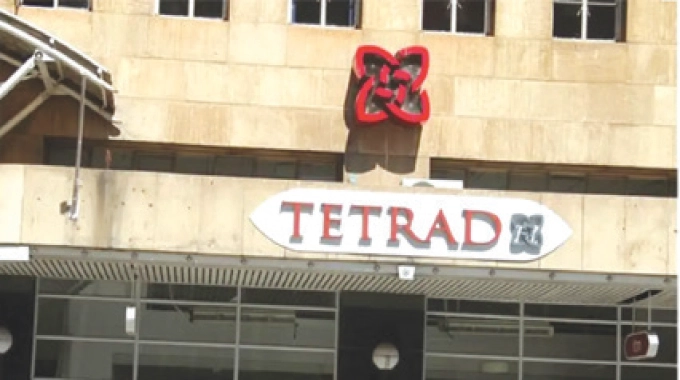
A MINORITY shareholder of Tetrad Investment Bank (TIB) has filed for corporate rescue to avert the potential liquidation of the struggling financial services institution.
In High Court papers filed two weeks ago, Dimitrios Divaris, executor testamentary of the estate of Vassilliki Divaris argues that TIB is in financial distress and only corporate rescue, a local form of bankruptcy protection can save the bank.
“Corporate rescue is ideal in the circumstances as it affords the applicant an opportunity to rehabilitate, obtain a moratorium from execution of judgments by litigants, develop and implement a sound corporate rescue plan that secures the rights of all affected persons and preserve value to the shareholders by avoiding liquidation…which otherwise has prospects of resuscitation,” Mr Divaris argues.
Mr Divaris has nominated Mr Knowledge Hofisi of Arufin Capital as corporate rescue practitioner.
TIB was incorporated on 12 June 1995 as Tetrad Securities Limited.
The institution commenced operations in 1996 after obtaining a licence to operate as a discount house in terms of the Banking Act. Tetrad Securities Limited’s discount house licence was converted to a merchant banking licence on 6 March 2009.
But its license was withdrawn by the Reserve Bank of Zimbabwe in 2014. In 2015, the bank was then placed under provisional liquidation, while it looked for a new investor.
In 2017, a scheme of arrangement was implemented and left the bank in the hands of depositors after a debt-to-equity swap.
However, this measure did not result in immediate cash flows to the bank, according to Mr Divaries.
“Cash flows to the bank could have improved if the first respondent (TIB) borrowed using the restructured statement of financial position or using the same to attract a new investor who then injects fresh capital into the bank,” he argues. “It is my considered view that the first respondent is reasonably likely to become insolvent within the immediately ensuing six months. My fears are informed by the first respondent’s audited financial statements for the year ended 30 September 2021.
In the audited financial statements, the auditors raised misstatements on financial assets held to maturity, failure to access the banking system, transactions not captured, inadequate audit evidence over the foreign currency reserve movement, and unresolved matters within other liabilities and other assets, among others.
The auditors could not vouch for the authenticity of the financial information contained in the financial statements. For example, the auditors failed to obtain documentation for the movement of $10,6 million in the suspended interest balance and $9,2 million to support the movement in foreign currency reserves.
The statements also show a “significant dissipation” of the assets by 16,8 percent from $1,7 billion to $1,4 billion.
In the same period, the accumulated loss went up by 15,8 percent from $3,8 billion to $4,4 billion, “putting to rest any reasonable hopes of restoring profitability…in the foreseeable future unless an investor with a clear financial resuscitation plan and financial capacity to inject meaningful capital is taken on board,” Divaris further argues.
TIB has been making consecutive operating losses since 2018 “thus pointing to serious solvency issues.”
TIB had a negative capital of $1,4 billion against a US$25 million regulatory minimum capital requirement. Even the historical figures of ZW$924 million has always been way below the required threshold. “It is clear that from 2015 up to 2023, the bank has failed to raise the minimum capital requirement of US$25 million, and this shows that first respondent is seriously undercapitalised.
In all circumstances regarding the above factual and telling findings, the auditors could not obtain sufficient audit evidence to conclude on the appropriateness of the use of the going concern assumption in the preparation of the financial statements.
“The above conditions indicate the existence of a material uncertainty that may cast significant doubt on the bank’s ability to continue operating as a going concern.
“It casts serious aspersions on the ability of the company under the stewardship of the current management regime to avoid liquidation. Creditor and shareholder value cannot be secured.
“If recapitalisation of TIB does not receive prime attention, it will inevitably go under liquidation. The bank has failed to raise any meaningful fresh capital over the years due to the shortcomings of the Board which may be pursuing a different trajectory.”
In December last year, Mr Divaris secured a High Court Order barring major shareholders from holding an extraordinary general meeting (EGM), which sought approvals to surrender the license and transform the bank into a property management firm.
The bank is estimated to have a US$13 million asset portfolio. – The Herald