


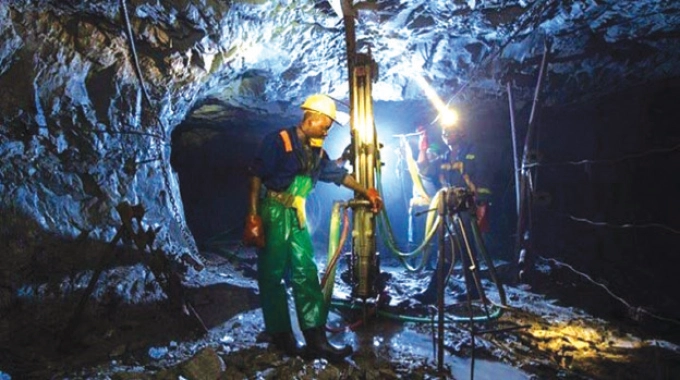
ZIMBABWE’s mining sector has performed positively in the last two years largely due to growing support from the Government through enabling policy shifts as well as strong commodity prices on international markets, economic analysts have said.
Leading equities research firm IH Securities said in its strategy report for 2023 that the mining sector had seen increased investment both from the Government and private players.
“The mining sector in Zimbabwe has experienced a good run in these two preceding years and growth for the sector has leapt from 5,9 percent in 2021 to an estimated 10 percent in 2022.
“Capacity utilisation for the mining sector in 2022, according to the Chamber of Mines Zimbabwe, remained relatively flat compared to the preceding year adding another percentage point to 81 percent,” IH said.
Notable developments in 2022 include the Tharisa Plc breaking ground at Karo mine, a platinum group metals (PGM) greenfield in which US$391 million is expected to be spent over the next three years.
Other projects commissioned in 2022 include the US$17 million BIOX plant by listed miner Riozim, which becomes the biggest of its kind in Africa and has contributed to a 200-fold increase in average monthly output.
IH Securities said investments into the precious metals sub-sector has been yielding results with strong performances being displayed across the categories.
“Incentives put in place for small-scale miners such as the establishment of provincial gold centres have reduced leakages resulting in increased gold output,” said the research firm.
It noted that gold prices in 2022 displayed more volatility as a response to developments in interest rates but remained above the long-term forecast rate of US$1,650.
IH said production for platinum is expected to shed off a percentage point to 13,2 tonnes whilst prices eased 12 percent.
On other hand, Zimbabwe is currently the World’s 6th largest producer of lithium and holds the largest reserves in Africa.
Annual output for Zimbabwe has been averaging 1600 tonnes with most of the product mined from the Bikita pegmatite.
IH said oversupply and other market factors led to a downturn of the subsector between 2018 and 2020, however, renewed demand for electric vehicles (EV) batteries has driven average concentrate pricesup 352 percent to US$2,700 with further upside foreseen in 2023.
“Additionally, battery grade lithium carbonate hit an all-time high of US$74,475/tonne in 2022 triggering a rush to secure supply.”
In December 2022, the Government banned exports of unprocessed ore to promote beneficiation.
Infrastructure by large-scale miners supports value added up to concentrate level. In addition, effective 1 January 2023, the royalty rate for Lithium was upped to 5 percent.
Within the lithium sector, transactions conducted in the past two years include the acquisition of Bikita Minerals by China Sinomine Group for US$200 million, acquisition of Arcadia Lithium mine by Huayou for US$422 million, the acquisition of 51 percent of Sabi Star mine by Chengxin Lithium Group for U$76,5 million.
Meanwhile, the 2023 National budget allocated $1,5 billion for mineral exploration activities in order to pave the way for feasibility studies as it doubles down on its mining drive. – The Herald