


SEVERAL roads in Gweru are being rehabilitated by the Government under the Emergency Road Rehabilitation Programme (ERRP 2) with a total of 436km of tarred roads and 647km of gravel roads having received a major facelift so far.
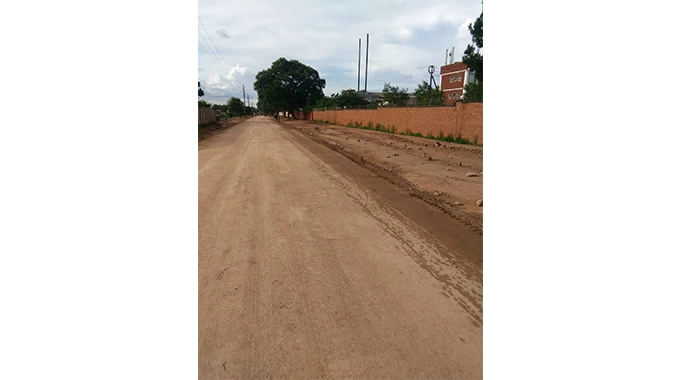
Some of the rehabilitated roads include Mambo-Woodlands Road and Chidhanana Road in Mkoba 16 and Igonde Road next to Mkoba Teachers’ College, which was no longer trafficable as it was littered with potholes.
The rains that have pounded most parts of Gweru rendered most of the roads inaccessible, with motorists having to weave their way through pothole-ridden roads.
The Government has so far spent over $1 billion on road rehabilitation, graveling and drainage structuring as part of the Second Republic’s ERRP 2 launched by President Mnangagwa in 2021.
Road construction falls under the infrastructure cluster and roads are regarded as key economic enablers in line with the vision of attaining an upper middle-income economy by 2030.
Motorists who spoke to a Chronicle news crew said driving had become a nightmare as most roads in the city were now virtually untraffickable.
They said the potholes were increasingly becoming a hazard to motorists and causing accidents.
“We are very happy with the progress that is happening here. Most of the roads were now an eyesore and portrayed a bad image of our city. We are very grateful to the Government for addressing those challenges,” said Mr Timothy Sibanda, a motorist.
Mrs Tecla Runesu said: “Well, it’s finally happening. I am glad that we can finally navigate our roads without worrying much. We used to have problems with potholes such that we found ourselves changing ball joints and tyres every now and then.”
Midlands Provincial Roads Engineer Denis Mupfurira said there are similar projects across the province, which are being implemented by the Government in line with the Second Republic’s inclusive development agenda.
“We have rehabilitated Mambo-Woodlands Road, Chidhanana Road in Mkoba 16 and now Igonde Road next to Mkoba Teachers’ College. More similar projects are in the pipeline,” he said.
“We are doing similar projects in Kwekwe and Gokwe as well. We noted that councils were finding it difficult to cope with the demandsin terms of road rehabilitation such that motorists were at the receiving end, and as such we are have chipped in.”
One of the contractors, Mr Farai Mashingaidze, of Nestanet (Pvt) Ltd, a Gweru based company, said they had finished re- graveling Igonde road and is expected to be tarred soon.
“We are responding to President Mnangagwa’s plea for Zimbabweans to be masters of their own destiny. The President is on record saying we should build our country brick by brick and we are simply playing our part by rehabilitating road by road,” he said.
Under the Infrastructure, Utilities and Digital Economy cluster, Zimbabwe’s economic blueprint, the National Development Strategy (NDS 1) prioritises completion of road rehabilitation projects.
The main aspirations of NDS1 include infrastructural development as a key enabler in attaining Vision 2030.
NDS 1 notes that “a road can become an economy” and in this regard, focus will be on the development of feeder roads into communities as a way of developing underdeveloped remote areas.
Government launched the ERRP2 in 2021 under a budget of $33,6 billion.
This year, the Zimbabwe National Road Administration set aside $93 billion to be distributed among the four road authorities, Department of Roads, Urban Councils, Rural District Councils and Rural Infrastructural Development Agency (Rida), previously known as the District Development Fund (DDF). – The Chronicle