


Gogo MaMhlophe (80) says she grew up in a Dete that had plenty of green, leafy trees with fruits that could easily sustain both animals and humans.
She remembers the days she went to school and would meet more than five elephants along the way. There would also be fresh prints of other wild animals along her path.
Gogo MaMhlophe says the elephants would go about their business, eating wild fruits or drinking water from a nearby river without troubling anyone.
Elephants around her home area in Dete, Hwange District, Matabeleland North province, would sometimes go near classrooms while they were learning and no one would panic as they knew they were not violent animals if not bothered, she said.
When asked if that is still the case, Gogo MaMhlophe said things have not been the same since the early 2000s as animals no longer live in harmony with humans as a result of lack of resources.
Gogo MaMhlophe said human beings and wild animals have become the worst of enemies in Dete.
Climate change is aggravating human-wildlife conflict as they compete for limited resources in order to survive.
The impact of climate change has resulted in significant decreases in crop yields and available grazing areas for livestock due to decreasing rainfall. As a result, competition between game and livestock has increased.
Zimbabwe’s elephant population is estimated to be more than 100 000, which is more than double its ecologically sustainable carrying capacity of about 45 000.
According to research, climate change is an alteration in global or regional climate patterns, in particular, a change apparent from the mid to late 20th century onwards and attributed largely to the increased levels of atmospheric carbon dioxide produced by the use of fossil fuels.
It can also be defined as the long-term alteration of temperature and typical weather patterns in a place. Climate change could refer to a particular location or the planet as a whole and it may cause weather patterns to be less predictable.
These unexpected weather patterns can make it difficult to maintain and grow crops in regions that rely on farming.
Dete is a small railway re-crewing depot and developing town on the Bulawayo-Hwange-Victoria Falls railway line lying near Hwange National Park.
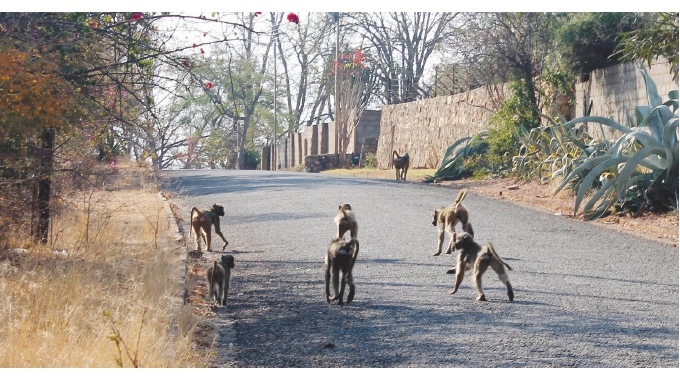
Because it is near the national park, residents are often treated to seeing wild animals from time to time.
Gogo MaMhophe said when they were growing up, they never had cases where wild animals destroyed homes and killed people without being provoked.
“The animals knew how to keep to their boundaries and they didn’t bother any human beings. But now because of climate change, the vegetation is no longer as thick as it used to be and some trees no longer bear many fruits which is causing competition between the animals and the people. You’ll find baboons and elephants in people’s gardens and homes trying to get food. They go as far as being violent when they see anyone who might be a hindrance to their source of food. We often hear stories of lions eating people’s cattle and human beings being attacked. I don’t really blame them because food for the animals is no longer as vast as it used to be,” she said.
Gogo MaMhlophe said as a result of drought, animals are slowly moving away from the area to new locations where they can get water and enough food.
Dete Residents Association Chairman and businessman Mr Douglas Mpofu said climate change has affected businesses in the area. He said fruits that grow in the area have become a source of income for many who are now over-exploiting them.
Mr Mpofu said some animals were slowly becoming scarce as they are moving further away from the area.
He said people used to harvest fruits like mangoes in large quantities and leave some for the animals, however, because of climate change, the fruits are now not as abundant as before, forcing authorities from the Zimbabwe Parks and Wildlife Management Authority (Zimparks) to be strict on the harvesting of wild fruits.
“The mining activities in the area have worsened the situation. Something needs to be done fast otherwise Dete will become a ghost city that many will not recognise,” he said.
Mr Mpofu also highlighted the shortage of water in Dete adding that this affects businesses operating in the area.
He said those who relied on harvesting fruits for sale are now struggling as they’re no longer available in large quantities.
“Something should be done immediately because the area is becoming poorer by the day. With the way things are, people might end up living like the animals as they look for greener pastures.”
Environment, Climate, Tourism, and Hospitality Industry Minister Nqobizitha Mangaliso Ndlovu
Environment, Climate, Tourism, and Hospitality Industry Minister Nqobizitha Mangaliso Ndlovu said as a result of climate change, rainfall has become erratic and this has caused high migration of some animals in search of greener pastures.
He said animal growth, particularly that of elephants, is another reason why they are migrating in order to look for places with better space and green pastures.
“From a park’s point of view, I would recommend scientific research to find out what exactly are the causes of the migrations,” he said.
In a recent interview, Zimparks spokesperson Mr Tinashe Farawo said there was a need to educate communities on climate change issues and conservation solutions.
“We need to educate people that there is a problem first, in that way they can also be part of the climate and conservation solution. As a result of an increase in human and wildlife populations, we have continued to see the conflict between the two escalating,” said Mr Farawo.
Zimbabwe Parks and Wildlife Management Authority (Zimparks) spokesperson Mr Tinashe Farawo
He said it was imperative that elephant populations are controlled.
“It’s high time animals pay for their upkeep and culling is a potential revenue stream. We last did culling in 1987, as of now, there have not been any mechanisms to control elephants. The most pressing challenge is the number of animals we have. We need to manage the numbers. The current overpopulation of elephants is a disaster waiting to happen, especially now when climate change has ravaged most of the farmer’s crops. Communities find themselves fighting over the limited food with animals,” said Mr Farawo.
“At the last COP in Geneva, we put up a proposal as a country to ensure communities speak for themselves and their issues are not voted for by people without any contextual understanding.”
Mr Farawo said when parks run out of water, animals tend to scavenge for it within human settlements.
“We have lost many lives as a result of human-wildlife conflict and the numbers could go up,” he added. – The Chronicle