


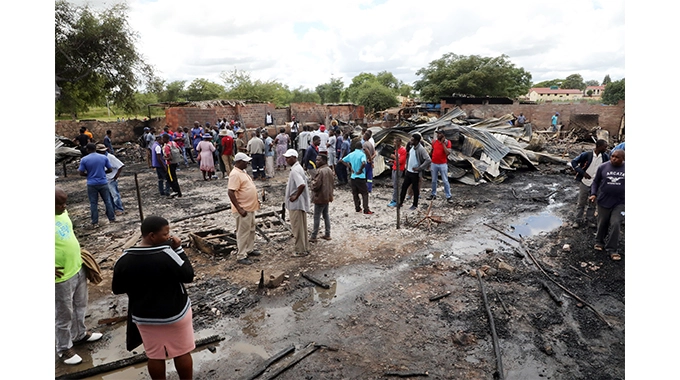
GOVERNMENT will activate its emergency support system for disasters with the view of assisting scores of small-scale traders who lost millions worth of property at the Mpopoma Outspan factory following a fire incident on Wednesday morning.
The provincial civil protection unit is set to be deployed to assess the extent of the damage to guide Government in mapping an assistance strategy.
On Wednesday, traders made a passionate appeal to Government for an emergency rescue package to resuscitate the once-thriving ventures, amid indications that the bulk of them had not insured their business.
The traders were left counting losses when the entire complex was reduced to ashes after a fire engulfed the factory early Wednesday.
Large quantities of timber, sofas, bed-making material and tools of the trade were severely damaged.
According to a Bulawayo Fire Brigade official preliminary report, the suspected cause of the fire was “carelessly discarded lit material”.
The estimated value of the property is $350 million while the estimated loss is $175 million. The traders are now appealing to Government to assist with funds so they can make a fresh start.
When a Chronicle crew arrived at the grim scene, stall owners were seen making desperate efforts to retrieve their wares amid a raging inferno.
Acting Bulawayo provincial affairs permanent secretary, Mr Simon Saunyama urged affected traders through their representation to make a formal request for assistance. He said finer details will emerge after on-site assessment.
“In cases of disasters of such a magnitude, we will activate a civil protection unit to assess the extent of the damage to give us an indication on what assistance can be rendered,” he said in an interview.
“In the meantime, affected people should approach the Government and make a formal request for assistance.”
Former spokesperson of sofa manufacturers, Mr Claudius Java said they were pinning hopes on Government for a bailout package.
“We are asking the Government to assist traders to resuscitate operations. Some of our clients are now demanding their orders and refunds by those who had paid in advance,” he said.
“We hardly have savings to refund clients, buy stock and equipment. We are pleading to the Government for a bailout. This is urgent. We don’t have insurance policies so getting back to business would be a struggle.
“Our hope is the Government coming to our rescue. We are financially crippled. As a matter of urgency, we appeal to the Government for money.”
Commenting on the tragedy, Bulawayo Chamber of SMEs co-ordinator Mr Nketha Mangoye Dlamini emphasised on the need for SMEs to have elaborate disaster risk recovery strategies to prevent unforeseen losses as many such small businesses crumble due to accidents and theft.
“We once held a meeting with SMEs on the issue of insurance looking at fire incidents, theft of property including cash in transit,” he said.
“We had two organisations which were offering good terms in terms of premiums. We encouraged our members in the SMEs sector to ensure that they get insurance to cover eventualities, as what happened in Mpopoma.
“It’s a sad situation and most probably, most of those SMEs did not have insurance. It’s a huge loss when you look at the resources destroyed.
“They had very high-quality products but unfortunately disaster struck. We will keep on encouraging members to insure their properties.”
Mr Dlamini said for planning purposes, most of their members do not look at the importance of insurance in their long-term projections. Most of their planning is short-term, he said.
“We need to train them and build their capacity so that when they do their planning, they have long-term work plans including disaster risk recovery strategies,” said Mr Dlamini.
Over 700 jobs were lost while official members in the association database are said to be 227.
The factory, popularly known as Spamprekini, is situated along Nketa Drive adjacent to Mpopoma Recreational Park.
So enterprising was the factory that Mpopoma Outspan Association had perfected its operations to a level where both big and small buyers from different parts of the country flocked into the humble factory to place their orders.
SMEs in Bulawayo are distinguishing themselves through quality products in different sectors covering textile and clothing, engineering, food processing, art and craft, among others.
The growth of the SME sector is critical in the country’s drive to expand job creation, substituting imports and beefing up export volumes.
This is why in 2020 President Mnangagwa launched the Micro, Small, and Medium Enterprises (MSMEs) Policy (2020-2024), which seeks to ensure that all businesses play part in the national development agenda for the country to realise an upper middle-income status by 2030.
To show support for the sector, the 2023 National Budget saw the allocation of $3 billion to the SMEs through Small and Medium Enterprises Development Corporation (SMEDCO).
The 2022 FinScope Micro, MSMEs and Consumer Survey revealed that the country’s economy is now dominated largely by micro, small and medium enterprises (MSMEs), which contribute up to US$8,6 billion (60 percent) to gross domestic product. –