


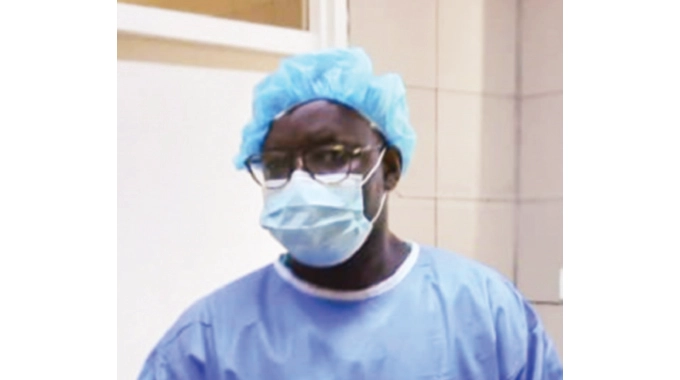
A New Zealand-based surgeon this week led a team of local doctors to perform the first ever gynaecological procedure using a new technique that leaves no scars and allows the patient to heal faster.
The technique, termed vaginal natural orifice transluminal endoscopic surgery, is a divergence from the usual open abdominal and keyhole surgeries.
Speaking to The Herald at Sally Mugabe Hospital yesterday, Dr Elliot Macknzie, a gynaecologist specialising in urogynaecology and minimal access surgery said he had decided to share his knowledge and experience with the local team of doctors as his way of giving back to his home land.
“I am based in New Zealand but Zimbabwe is my home. I am here on holiday but I have some time to actually come around and share my experience with my colleagues. I have a close educational relationship with obstetricians and gynaecologists in Zimbabwe. I did my undergraduate training here so I know most of the people who are working here,” he said.
“A large part to my coming here is because the local doctors have shown a keen interest in doing things that are up to date and in line with international standards. We felt that direct skills transfer was the best way to do that.”
He said having gone and trained overseas he knew their experiences were a little different so he had found it worthwhile to share new techniques.
The doctors are currently running a five-day gynae laparoscopic procedures camp at Sally Mugabe Hospital where they are performing three surgeries per day.
The camp is also focusing on training and teaching and sharing with the local surgeons about vaginal natural orifice transfuminal endoscopic surgeries.
“Surgery for hysterectomy has largely been done with open abdominal or laparascopic surgery but we have found a way of doing scarless surgery where women who have uterine problems can have their surgeries done through the vagina in such a way that they do not have significant pain or bleeding after the surgery has been done and that they can go home and recover quickly,” said Dr Mackenzie.
By yesterday, three surgeries had been completed successfully with 12 more expected to be done by January 20.
“Traditionally we have what is called total abdominal hysterectomy where a large incision is made on the abdomen and laparoscopic or keyhole surgery where small incisions are made on the abdomen as well.
“This new approach combines the best of those two approaches as well as vaginal approaches in such a way that we have better visibility when we look inside and we are more precise in terms of what we are doing. It also allows us to do a bit more than just a hysterectomy when we are operating from the vagina,” he added.
With most public hospitals facing a challenge of malfunctioning equipment or shortage of sundries, there has been a backlog of cases in need of laparascopic surgeries.
Mrs Abigail Chinyoka (54) of Kambuzuma has been on the waiting list for a hysterectomy since last year when doctors discovered she had cancer cells in her uterus.
“I first realised that something was wrong when I started losing weight and I could not keep any food down. I went for a pap smear but it did not show anything wrong. I then came here for VIAC (Visual Inspection with Acetic Acid and Camera) and they referred me for another pap smear. The results showed that I had cancerous cells in my uterus after the biopsy was done. I opted to have a hysterectomy,” she said.
In November last year, she was due for her procedure but on four occasions she was discharged as there was not enough medical sundries for the operation to be done.
Fortunately, she was one of the first to be called this week for Dr Mackenzie’s camp.
“On Saturday, I came and did all the blood tests and on Sunday, I was admitted and yesterday (Monday) they removed the uterus. They did not cut any part of me open so I have no scar, I did not bleed and I am not feeling much pain, only slight pain inside.
“I think this process is milch better than the ones we used to know about.” – The Herald