


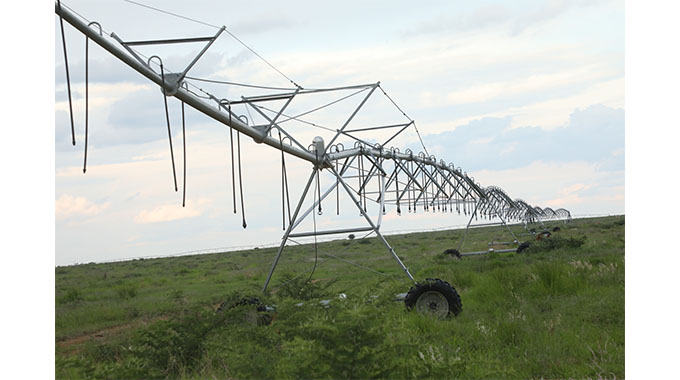
TUCKED deep in the heart of the semi-arid Lupane District in Matabeleland North Province, the Bubi-Lupane Irrigation Scheme, an enviable farming model, has transformed the lives of the local community through large-scale irrigation farming.
For 10 years, the vast tract of arable land in the provincial capital of Matabeleland North, has been lying idle despite its huge potential to improve the locals’ livelihoods. It was revived by the Government through the Agricultural Rural Development Authority (Arda).
Today, the irrigation scheme, which is situated in Mpofu Village under Chief Mabhikwa, has been turned into a green belt. It is one of the flagship Government projects that symbolises hope for 90 families.Through Government support, Bubi-Lupane Irrigation Scheme helped transform subsistence agriculture at the household level into commercial agriculture as part of rural development and industrialisation in line with Vision 2030, which is anchored on driving the country’s economy into an upper middle-income one.
The 200-hectare irrigation scheme was in 2021 identified as a pilot project for an integrated business model to be replicated by 450 irrigation schemes across the country as the Second Republic accelerates rural development and industrialisation.
In September 2021, President Mnangagwa launched the Arda Vision 2030 accelerator model programme at Bubi-Lupane Irrigation Scheme to stimulate rural industrialisation through agricultural development.
Under the model, each district across the country will have 200 hectares under irrigation with the beneficiaries being locals.
Lupane is a rural semi-arid area with a growing population and after some infrastructural expansion was made the capital of the province.
The area falls under the Savanna climate largely characterised by woodlands and grasslands. Over the years, the local community has been largely practising subsistence farming, relying on seasonal rainfall for watering crops.
In interviews during a tour of the irrigation scheme by the Minister of Lands, Agriculture, Fisheries, Water and Rural Development Dr Anxious Masuka on Tuesday, farmers said the project has transformed their lives and they are eyeing a bumper harvest.
The irrigation scheme draws water from the Bubi-Lupane Dam. Farmers have put 60 hectares under maize while 120 hectares is under sunflower.
Each hectare was allocated 25kg of maize and 5kg of sunflower seed under the Presidential Input Scheme.
One of the plot holders, Mrs Sikhulile Moyo, said the scheme has helped transform her life.
“I was paid US$400 and $300 000, which were the proceeds from farming at the Bubi-Lupane Irrigation Scheme. From that money, I managed to buy building materials and paid school fees for my children,” she said.
Mrs Moyo said following the revitalisation of the scheme in 2021, they have started reaping the rewards of their labour.
“My husband is unemployed and as a family, we struggled to make ends meet until Government availed us of this opportunity for us. Since 2021 when this irrigation scheme was revived, we have been recording bumper harvests,” she said.
Mrs Olly Moyo said through their efforts, they are contributing towards boosting the country’s food security.
“The irrigation scheme has enabled my family to be food secure. I am also glad that in my small way, I am also contributing to Zimbabwe’s food security,” she said.
The chairperson of the irrigation scheme, Mr Douglas Khumalo, said their hard work is paying dividends. He commended the Government under the Second Republic for prioritising the rehabilitation of the irrigation scheme and transforming it into a business venture.
“The Grain Marketing Board has cleared the monies owed from last year’s yield and people are benefitting from their sweat. Each farmer received $500 000 and we are now waiting for the US dollar component of US$370,” he said.
Arda chief executive officer Mr Tinotenda Mhiko said the irrigation scheme is a success story for the local community.
“This is our fourth successful crop cycle established under the revolutionary Vision 30 Accelerator Model which is a critical component of the Rural Development 8.0 programme. We have 60 hectares of maize and two blocks of 60 hectares of sunflower,” he said.
“We chose sunflower as our rotational crop and to contribute to import substitution. The biomass that comes from the foliage of the sunflower is helping us manage the sustainability of the desert Kalahari sands of Lupane. We are expecting a good yield this year and the crop is looking good.”
Dr Masuka said plans are underway to further expand the irrigation scheme.
“The Vision 2030 Accelerator Model is the President’s Vision of uplifting and empowering rural communities towards Vision 2030. This is the nexus of the philosophy of agricultural development, which leads to rural development to accelerate the attainment of Vision 2030,” he said.
“We have a value addition and beneficiary component for this project coming in. We want to expand the irrigation to 480 hectares and already some substantive land clearing has been done and we have received money from the budget.”
Dr Masuka said Government has identified five sites along the Gwayi-Shangani-Bulawayo pipeline similar irrigations would be established as part of efforts to scale up rural development. – The Chronicle