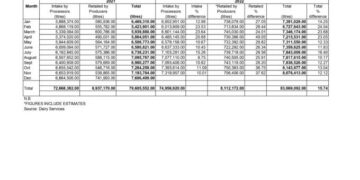



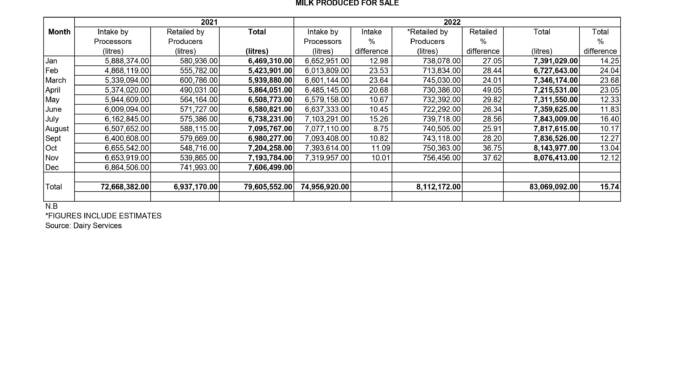
Zimbabwe’s dairy industry produced 91 million litres of raw milk last year, up from 79,6 million litres the previous year, surpassing its 2022 production target by around a million litres. Lands, Agriculture, Fisheries, Water and Rural Development Permanent Secretary Dr John Basera told The Sunday Mail that Government and private sector interventions have anchored the growth of the sector. The agriculture sub-sector is projected to grow into a US$1,9 billion industry by 2025. “Total milk production increased by 14,3 percent from 79,6 million litres in 2021 to over 91 million litres in 2022,” said Dr Basera. “Milk powder imports declined by 17 percent from 8,9 million kg in 2021 to 7,4 million kg in 2022, moving us closer to self-sufficiency.”
He said the country’s dairy herd had increased significantly through local breeding, while imports have been hampered by outbreaks of diseases, particularly foot and mouth, in neighbouring countries. “These growth trends are coming at the backdrop of several interventions by Government, private sector and development partners in the sub-sector. “All these interventions and touch points are contained in the Livestock Recovery and Growth Plan, with deliberate programmes to increase the dairy herd from 19 000 in 2021 to 29 000 in 2022. porn leaks Lexy “These include dairy heifer programmes funded through the private sector,” he said. Through Government’s initiatives, said Dr Basera, there has been significant growth in daily productivity per cow. “Deliberate programmes to upscale milk production and productivity per cow include the Presidential silage programme, which supported more than 1 500 smallholder dairy farmers with a standard input package comprising maize seed, basal fertiliser, top dressing fertiliser for one hectare of silage. “Silage is a highly nutritious and affordable feed option which Government is promoting under the ‘own farm feed formulation’ programme that started in 2021,” he added. Dairy farmers are being supported under the Command Silage Programme, facilitated by the Agricultural Finance Corporation and CBZ Bank. The facility is modelled around the National Enhanced Agriculture Productivity Scheme, formerly known as Command Agriculture. “Medium to large farmers are also being supported under the Command Silage Programme,” said Dr Basera. “Dairy farmers get working capital support in the form of inputs, and recoveries are made at the point of sale through a stop order arrangement with milk processors.”
In a separate interview, director of veterinary field services in the ministry, Dr Jairus Machakwa, said: “We have taken a stance to transform the agriculture sector. Our permanent secretary is on record saying we should transform the sector and work with all stakeholders. “We have been directed to strengthen our extension services arm as a ministry so that we are next to the farmer, ready to assist and give guidance,” he said.– Sunday Mail