
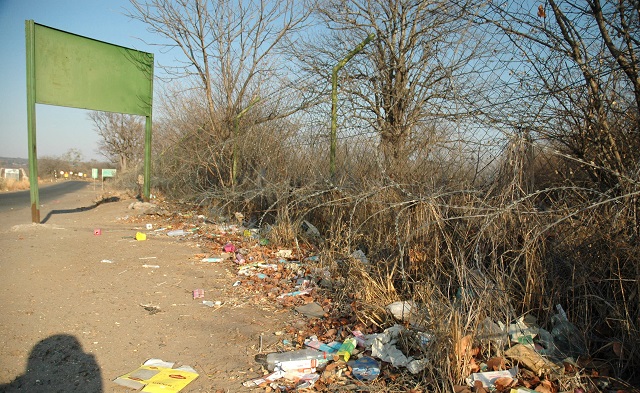
LITTERING along major highways in Zimbabwe continues to be an environmental threat with communities calling on stakeholders and environmental agencies to urgently address the issue if the country is to retain its status as the cleanest in Southern Africa.
Stakeholders have on several occasions called for stiffer penalties on litterbugs.
In 2018, President Mnangagwa launched a National Clean-up campaign aimed at ensuring that the country has sustainable environment management and waste disposal systems to meet its goal of attaining an upper middle-income economy by 2030.
Following the inception of the National Clean-Up, which takes place on the first Friday of every month, the President has been spearheading the campaign to make communities cleaner.
The declaration is in accordance with Section 73 of the Constitution of Zimbabwe which guarantees every citizen of Zimbabwe “the right to an environment that is not harmful to their health and well-being”.
However, some citizens continue to ignore the calls for a clean environment, especially along major highways and in cities. Service centres and lay-byes along major roads are plagued with litter as the travelling public indiscriminately dumps litter.
A Chronicle news crew observed that several sections of the Bulawayo-Beitbridge Road are heavily littered with empty containers of fast foods, empty bottles of beer and soft drinks, and waste plastic paper among other forms of litter.
A man who operates a food caravan in Esigodini said the road had become an eyesore and that councils should implement measures to curb highway littering.
“There are a lot of buses that pass through here. Passengers buy food stuff and after consuming it they then throw it away through the window creating an environmental eyesore,” said Mr Njabulo Ngwenya, a roadside vendor.
“I implore the Environmental Management Agency (EMA) and council to enforce by- laws and even if it means punishing these public transport operators in the event a passenger throws litter through the window.’
Mr Ngwenya said litter is an also serious health hazard to livestock.
Speaking during a recent stakeholders meeting in Fort Rixon, a local farmer, Mr Khulekani Sibanda raised the issue of highway littering, saying some cattle were dying after eating plastic waste.
“Some cattle tend to wander on the roadside and eat plastic waste. Whenever a cow chews plastic waster, it is likely to suffocate and some of the litter contains deadly chemicals,” he said.
The Beitbridge-Bulawayo Highway is a strategic road that links the country with neighbouring South Africa.
EMA conducts routine anti-litter awareness campaigns and educates the public on the need to keep the environment clean, including fining litterbugs.
In a statement, EMA urged companies in the plastic production sector to adopt innovative measures on their production systems through promoting the recycling of plastic for environmental sustainability.
“Enhancing circularity by promoting more sustainable consumption and production practices across the entire plastic value chain is key in addressing plastic pollution. Players in the plastic industry must work to eliminate problematic plastic packaging or products by redesigning products for enhanced sustainability and innovating their business models to move from single use to reusable plastic products,” said EMA.
“Packaging professionals also have an obligation to adopt environmentally sustainable practices, look at innovation to use the vast amounts of waste packaging that is already in circulation and to push for improved and aligned recycling methods.” – The Chronicle