


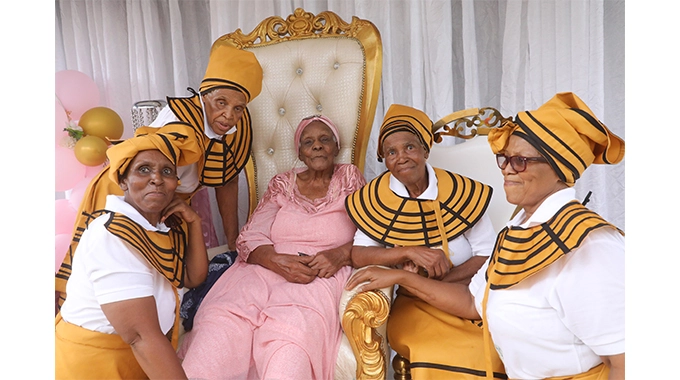
She was given the name Masamanisi as a reminder that on the day that she was born 100 years ago, her father received summons from colonial administrators after his cattle had strayed into a white man’s farm in Esigodini, Matabeleland South Province.
And yesterday, centenarian, Mrs Etta Masamanisi Mkwananzi received a special message from one of her 35 great-grandchildren, seven-year-old Nqobi Ndalwenhle Moyo.
“I love you and want to grow as old as you. Happy birthday khokho,” Nqobi said.
Exactly 100 years and one month after her birth, a bubbly Mrs Mkwananzi celebrated belatedly her birthday alongside her family and friends yesterday in Northlynn Suburb.
Four of her five still-alive daughters, first-born Ms Theliza Mkwananzi, born in 1946, her siblings Junior (1949), Ms Sithandiwe (1954), Ms Sihle (1959) and Ms Samukeliso (1961) were part of the joyful party. They were born nine but four are now late.
Mrs Mkwananzi only had two sons and the lastNdabezinhle passed away in 2018.
She has 26 grandchildren from her nine children, 35 great-grandchildren and one great-great grandchild.
Yesterday’s birthday celebrations were being driven by Mr Ndumiso Ndondo popularly known asMC Nduzza while Woza African Arts thrilled guests with their dances.
“I used to be angry when people called me Masamanisi but I later got used to the name. My mother told me that on the day that I was born, soon after she had her lunch, some messengers arrived with summons for my father alleging that his cattle had strayed into the farm of a white man. They took him on the very day I was born and he was charged over that. I have had little respect for whites but God tells that we must forgive those who wrong us,” said Mrs Mkwananzi who now has hearing challenges.
The granny met the love of her life Mr Magama Shadreck Mkwananzi in 1942 at Solusi Mission and they wed four years later, a year before the famous umnyaka wendlala in 1947.
Mr Mkwananzi passed on in 2004 at the age of 85 after 39 years of marriage.
“That year (umnyaka wendlala) nearly led to the demise of humanity in this country but I have to confess that I didn’t starve because I had a great harvest. I loved and still love farming which also may be the reason why I have remained physically stable. I urge everyone to embrace farming and safeguard against hunger,” she said.
The granny said when it comes to eating, her favourite is meat although these days it has to be well-boiled because of her tender teeth. Sour milk (amasi) is another favourite.
She said turning 100 years is a huge blessing to her especially when the world is now a disease haven.
“I owe my life to God, I am so grateful for achieving this milestone and being able to be with my great children on such a special day. I don’t know why God chose me to reach this milestone. My advice to the youth is for them to be disciplined and listen to their elders all the time. Pleasures of life usually lead to unexpected demise. Our youths must shun abusing themselves with drugs and alcohol. My husband died when he was 85 and I am 100 today, we both never took any alcohol,” said Mrs Mkwananzi.
She said the Covid-19 period was a very difficult period for humanity as it changed their way of life.
She was quick to point out that the scourge was still on. “Corona is still here although not as before but still it doesn’t mean we have to disregard what health authorities and Government tells us about this disease,” she said.
The granny brought people to laughter when MC Nduzza asked her if she fought in the country’s liberation struggle against the colonial regime.
“Ah you want to get me arrested, I don’t want to talk about that,” she said.
Her last born among the daughters, Ms Samukeliso Mkwananzi said their mother has been a source of inspiration for them, in all aspects of life.
“We are a blessed lot to be her children, sadly four of our siblings are no longer with us. Our mother is still the same person she was when we were still little kids, save for some unavoidable challenges due to age. If it was to her wishes, she could still be going to the fields to till the land because farming is in her blood,” said Ms Mkwananzi. – The Chronicle