



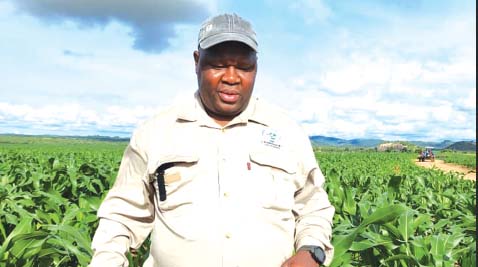
THE Government is committed to improving research and development (R&D), which is a key enabler in driving the country’s industrialisation and development agenda, Ministry of Lands, Agriculture, Fisheries, Water and Rural Development Permanent Secretary Dr John Basera has said.
Economic transformation and industrialisation being championed by the Government through the National Development Strategy 1 provides meaningful investment in research and development.
Te Government has allocated $16 billion out of $363 billion towards research and development and innovation in the ministry this year.
Speaking during the inaugural Research and Extension Symposium, Dr Basera said Vision 2030 accelerator can be achieved when all the necessary conditions for successful agricultural research are in place.
He said research results should closely mirror what actually subsists when the technologies are adopted on farms, or at any value chain point.
“Colleagues, the agricultural research-extension nexus is a catalyst for agricultural transformation, industrialisation and development. As such, the role of extension is crucial for the users to derive maximum benefits from research,” he said.
He said reports on performance of the various sub-sectors are testament of the direction the sector is taking and research-extension nexus offers huge opportunities on how to do things differently and amplify current successes.
“Our Agricultural economy grew by 36% and we are now self-sufficient in terms of food security. Wheat production has increased to 375 000 tonnes— a record wheat production since 1966. Productivity levels in maize and milk has also increased,” he said.
“Research will present us a chance to consolidate and expand on these successes, more so, if our research and extension efforts are collaboratively and seamlessly linked and coordinated.”
This Research and Extension Symposium provides a platform for all stakeholders to converge for purposes of sharing research results. It also provides a feedback platform on adoption of new technologies and challenges faced by farmers.
Professor Mandivamba Rukuni, a scientist who is also a veteran academic with extensive experience in facilitating land policy-making in Africa, said there is a need to concentrate on innovation and productivity.
“We are not doing well on institutional innovation as scientists because we are shy. The thing is we now have to increase productivity using less land, less water and less chemicals. We need to talk about the role of agriculture in the structural transformation of society,” he said.
This symposium also provided a critical perspective on improving the country’s agricultural and food systems transformation.
Zimbabwe’s food security depends on producing cereal crops, as well as increasing its production of fruits, vegetables and milk to meet the demands of a growing population with rising incomes. To do so, a productive, competitive, diversified and sustainable agricultural sector will need to emerge at an accelerated pace. – The Herald