


WHEN villagers in Mpumelelo Village 25 in Kachechete Ward started Vusanani Irrigation Scheme in 2014, their goal was to ensure food security for the whole community.
Since then however, the community has not been able to get irrigation equipment to water the land during the dry season.
Despite this, the project has sustained many families as the 59 members can pay school fees for their children, cater for their daily needs and provide food even during droughts.
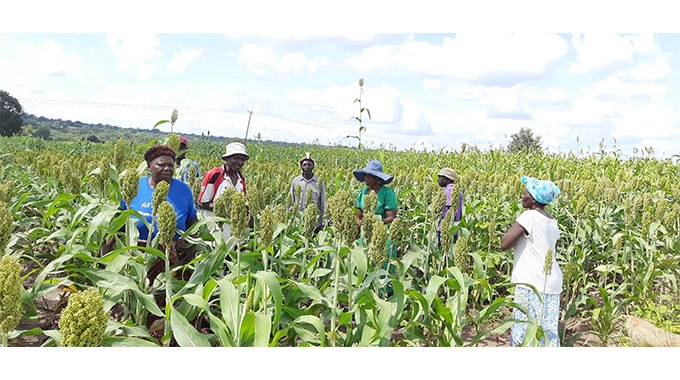
Members of Vusanani Irrigation project in Ndlovu outside Victoria Falls
Government last year launched the Agriculture and Food Systems Transformation Strategy, which envisions a Zimbabwe that is food secure.
The strategy also seeks to eliminate food imports, deepen exports, create up to 1 million jobs by 2025 and build a Zimbabwe powered by agriculture.
This is in line with the National Development Strategy 1 (NDS 1) towards attaining Vision 2030.
Government aims to establish irrigation schemes in every district across the country to ensure food security and rural development.
Located about 45km from Victoria Falls, the 1 500-hectare project has potential to sustain more livelihoods and multiply dividends if it is supported by an irrigation system.
Members grow a variety of grain crops, groundnuts and sunflower, which are rain fed.
They are drawn from BH10, BH25 and BH38, which are all under Mpumelelo and comprise the elderly and youths.
Each member has a 28 by 150 metre plot where they grow different kinds of crops.
On average, each farmer harvests about two tonnes of grain and hopes are high that production could increase under irrigation.
The project members are appealing for help to drill a borehole and install an irrigation system to intensify production.
They have so far approached donors such as Caritas and Amalima Loko who have promised to look into the proposal.
A well-wisher once sunk a borehole that was powered by a windmill near the piece of land but later took away the equipment after some disagreements with the community.
The site of the project was once a paddock and the donor had wanted no change of use while the community opted to convert it to an irrigation scheme for food security.
A Chronicle news crew visited the irrigation scheme recently and noted thriving maize, sorghum, millet, sunflower and groundnuts crops.
Some of the project members use Intwasa Conservation farming with help from Agritex officers and get some of the inputs from the Government.
BH25B Village Head Mrs Gladys Maphosa said the project is a source of livelihood as members are able to pay school fees, buy food, clothes and other necessities for their families.
“We started in 2014 when our fields had become infertile, causing droughts every season while families had grown big. This was a paddock for our livestock and the community resolved that we convert it into a community garden so that we grow crops all year round.
“After taking the issue to the village assembly, ward, District Development Coordinator and local authority offices, we then started clearing. Each member was allocated a plot where we grow crops during the rainy season.
“We wish the Government or any other well-wisher to help us with a solar powered borehole and irrigation system because we want this to be productive all year round. We want our children to go to school and graduate so that they develop our community while we also send some grain to the Gran Marketing Board,” she said.
Each plot holder was also allocated a 20 metre stretch along the perimeter fence to take care of.
Members of the scheme have surplus grain from last year’s harvest, compared to non-members who now depend on well-wishers and buying from shops.
BH25A Village Head, Mrs Esiline Moyo who is also a committee member for the irrigation scheme said even during drought, they get better yields compared to other farmers in the area.
“Each member can get two tonnes from the plot and we are food secure compared to those farming in the old fields hence our appeal for water for irrigation and a fence so that we grow crops during the dry season and supply the tourism industry in Victoria Falls,” she said.
Mr Makheyi Ndlovu, the scheme secretary said besides water, the project also needs a tractor to boost production.
He said plot holders are hardworking farmers but the challenge is that some are now old while others have no draught power to till their plots.
Another member, Mr Sindiso Maseko said they practice crop rotation to protect soil nutrition.
He said he had eliminated hunger from his family which has food all year round.
Mr Robert Mathe said besides challenges with irrigation, elephants are also a problem as they sometimes invade the plots and destroy crops.
“Now sorghum and maize crops are ready and this is the time when elephants give us problems. We need help with proper fencing to protect our crops. We can’t get poles from the bush because the Forestry Commission does not allow us to cut down trees,” he said.
Plot holders sometimes guard their crops at night.
Mr Busani Maphosa said non-members also benefit through menial jobs as they weed and harvest the fields in exchange for money or grain and other items.
He encouraged youths to participate in developmental projects in their communities in order to eliminate hunger.
A youth, Mr Nkululeko Dube said the project was a source of income.
“As youths, we’re grateful to our elders who came up with the idea of this project and allowed us to be members. We sometimes assist the elderly who can no longer till their land to show appreciation for being allowed to be part of this to feed our families.
This is why we’re appealing for help to commercialise this project and supply horticultural products to Victoria Falls,” he said. – The Chronicle