



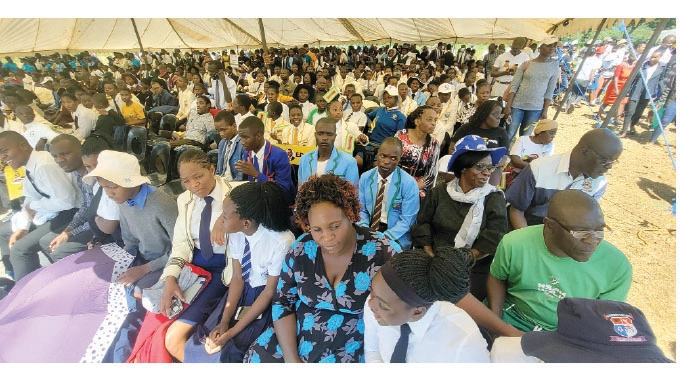
Recently, Zimbabwe celebrated the National Youth Day and it was a marvel to watch a number of youthful farmers being honoured with certificates by President Mnangagwa for their achievements in agriculture.
President Mnangagwa addresses youths during the National Youth Day celebrations at Lupane State University (LSU) campus in Matabeleland North
The youth walked proudly to the podium in Lupane, Matabeleland North province, where the National Youth Day commemorations were held, to receive their certificates.
And it was interesting that the young farmers were excelling in various aspects of agriculture, showing their huge interest in ensuring that the nation is well fed.
These youths who are in agriculture provided a good example for their counterparts who are known to take it lightly when it comes to attempting to venture into the sector.
The National Youth Day became an important day for those in agriculture to reflect on youth and their participation in the agricultural sector.
Under the Second Republic, youth empowerment programmes have featured more prominently with the goal to invest in young people and to increase their participation in the economy.
The country’s Land Reform must not die when parents die.
Land beneficiaries have a duty to teach their children farming and how to value the importance of land to the country’s survival.
Young people have a duty too, to learn and take interest in farming, to practise it and to pass on this land and farming legacy to future generations.
It is only through land that the Zimbabwean youth can be able to maintain their sovereignty and economic independence in the world.
All other races across the world keep a keen eye on land and farming to retain their identity, amass wealth and power in their territories.
Land is life and life is the land. Zimbabwean land beneficiaries must walk with the youth in helping them to appreciate and embrace agriculture.
Cecil John Rhodes, the Oppeinheimers, Rothschilds, Rockafellas, and all the imperialists understood the value of land to wealth, power and control.
They bequeathed these values to their youth. In Zimbabwe and most other African countries, it is increasingly becoming difficult to convince the “Facebook, Twitter and Instagram generation” to take up agriculture both as a job and a business.
Many of our youth complain that agriculture is hard and less attractive to venture into.
The sad irony is that our youth, who make up about half of the country’s almost 15 million population, do not want to have anything to do with food production, and yet they all love eating.
Some of our youth are unemployed and live in rural areas where there are huge arable lands, yet they are not keen to engage in agriculture for various reasons.
So many reasons have been given such as marginalisation, lack of training and limited access to credit facilities and equipment for farming.
In most of our rural areas, the elderly remain the backbone of our agricultural production with minimum participation by the youth.
Zimbabwe’s young women and men prefer to leave rural areas to seek employment opportunities in large towns and cities and across borders.
This has worsened our problems as a country. Food production will suffer and the country will turn to imports.
However, there is a glimmer of hope when our governments and international development partners take practical steps to promote the involvement of youth in the agricultural sector.
In recent years, a number of young people have won a string of accolades for farming.
President Mnangagwa has awarded young people prizes for excelling in agriculture.
He has also championed the Provincial Integrated Youths Skills Development Centres helping the young ones to take up livestock and crop farming.
Some young people are taking up farming seriously and are realising earnings from contract farming of beans, onions, peas, tobacco maize and other crops. The young achievers are feeling empowered, and with their earnings are buying assets to bolster their farming activities.
The Government and the Food and Agriculture Organisation (FAO) have rehabilitated irrigation infrastructure in various parts of the country.
Young people have benefited immensely from the programme, which was implemented by FAO and the Ministry Lands, Agriculture, Fisheries, Water and Rural Development.
Through the programmes, young farmers have received training on building market linkages, farming as a business, health and nutrition as well as promoting sustainable farming practices.
The rehabilitation of smallholder irrigation projects across the country by FAO, the Government and other partners is helping young farmers to create jobs and wealth for themselves.
It is heartening to learn that farmers at these irrigation schemes have allocated plots to young people to take up farming as a business.
The young people are now growing tomatoes, onions, groundnuts, maize, bananas, sugar beans for seed production and Michigan beans which they are supplying to the Zimbabwe Super Seeds company on contract basis and beans, tomatoes, onions to Klein Karoo and Cairns Foods.
Youth involvement in agriculture must be encouraged and promoted.
FAO sub-regional coordinator for Southern Africa Dr Patrick Kormawa recently remarked, “If we have young people as lead farmers, then I know we have a great future. We must involve our youth in farming. We must fight with our young people to kick out hunger and poverty.” – The Chronicle