


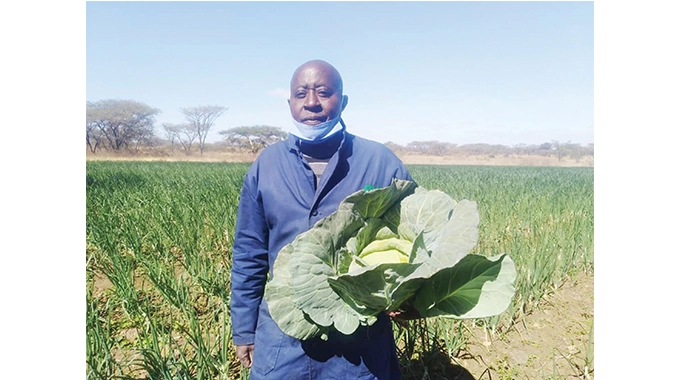
GWERU-based farmer Mr Gilbert Makore (66) has put 50 hectares under horticulture that include 20 000 plants of tomatoes and 10 000 cabbage heads.
Three hectares is under maize with a hectare of butternut and he has set his sight on planting 1,5 million onions this year up from a million last year. He also has cattle and goats.
Diversification into cabbages, potatoes, butternuts and tomatoes has seen him increasing production and productivity thereby maximising on returns at his farm.
Mr Makore, who attracted much interest into his farming activities after a Twitter post on April 28 2021 showing Irati onion plants at his farm, said he has now produced over two million plants to date.
With a hands-on approach, Mr Makore has embraced the concept of production and productivity spearheaded by the Ministry of Lands, Agriculture, Fisheries, Water and Rural Development at his Vashee Farm in Harben Park, about 14km from Gweru City Centre.
Mr Makore who joined the great trek to the United Kingdom before retracing his steps back home has been a force to reckon with within the horticulture business in Gweru.
A former soldier who retired in 1998, he went to UK shortly afterwards and came back in 2002 to take up farming.
He started living at the farm in 2003 and began serious farming in 2009.
There is a shop at the farm that is open all year round where vendors and residents come to buy – a development he attributed to hard work centred on production and productivity.
In an interview, Mr Makore said he is diversifying into several crops after realising that there is a market to feed in Gweru and other areas.
“I have realised that there is money in agriculture by working more on production and productivity. In this light, diversification into cabbages, potatoes, butternuts and tomatoes has seen us increasing production and productivity thereby maximising on returns at the farm. Maximising means getting some money back that would have been used to fund the production and some profit which is what is keeping us afloat,” he said.
Right now, Mr Makore said they have tomatoes growing and they will be ready for the market in three weeks or so.
“There are over 20 000 tomato plants altogether. In terms of potatoes, the crop we have will be mature in two months or so, and it’s on just over three hectares. Then we have 10 000 heads of cabbages and about a hectare of butternut and both crops will be ready just before the Easter holiday,” he said.
Mr Makore utilises drip irrigation and also uses overhead sprinklers at his farm.
“We have not started onions for this winter because we still have crops in the field and we still have time to catch up though. Last year we achieved one million onions and this year certainly more, maybe 1.5 million plants,” he said.
Mr Makore said he has been self-financing his projects at the farm.
He lamented reluctance by banks to give farmers loans.
“Yes we are growing but the growth is rather slow as compared to what we envisage. Banks don’t give us loans you know and that’s a challenge for farmers,” he said.
Mr Makore is into mixed farming and has crops all year round under irrigation and dry land on his farm.
He has placed 50ha under horticulture.
Besides crops, he rears livestock such as cattle, sheep, goats and first-generation road runners.
He has more than 100 goats and has discontinued sheep farming to concentrate on goats.
“At my farm, there is always an activity or a crop in the field for maximum utilisation of the land resource in line with production and productivity. My employees stay at the farm with their families so that we have a hands-on approach in all activities we do as a family,” said Mr Makore.
He said he works with local seed producers who advise him on how to grow certain crops to achieve maximum production per plant/crop or hectare.
Mr Makore said such value chains with seed producers and markets assist him in planting the right crop at the right time for the market.
“We have local seed producers who send their agronomists to supervise our crop and that is very important for us to realise maximum production. Farming as a business means you must engage specialists in the area for expert advice. As I have said, I have a manager and I am also hands-on. On a daily basis I get to the farm to see how the crops or livestock are doing,” he said.
Mr Makore has a staff complement of 10 permanent workers that stay at the farm.
“I have managed to construct staff accommodation quarters for the workers and their families and a greenhouse too. We have tractors and plans are underway to add more tractors and farming equipment to increase production and productivity,” he said. – The Chronicle


