


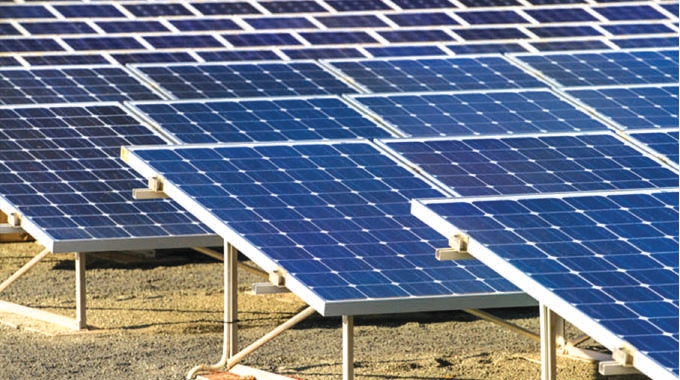
ZIMBABWE expects the granting of guarantees to Independent Power Producers (IPPS) to drive increased investments in solar energy and authorities have implored operators to take advantage of the recent Government Implementation Agreement (GIA) to expedite their investments and help the country boost clean energy production in line with global climate change mitigation efforts.
In December last year, the Government identified and recommended 27 IPPs with an estimated combined output of 1 000MW for support, a development seen as a massive boost to the projects as the Second Republic is speeding up investment by the IPPs with main focus on solar projects.
The Government has guaranteed economic tariffs to qualifying IPPs solar projects that would have passed the screening process.
The GIA has three major components namely – Project Development Support Agreement, power purchase agreement (PPA), and the Reserve Bank of Zimbabwe (RBZ) undertaking for foreign currency convertibility and transfer.
Finance and Economic Development Minister, Professor Mthuli Ncube, has said the Government now expects solar projects to accelerate investments riding on the above supportive policy measures.
He said in line with the national vision of attaining an upper middle-Income status by 2030, the major key enabler in realising sustained economic growth is a table, sustainable, reliable, and affordable power supply.
“Over the next few years, there will be accelerated investments in the solar energy space where, as the Government, we have decided to offer guarantees, what we call power purchase agreements between producers of electricity and the buyer being Zesa,” he said.
“The guarantee stipulates that if ZESA cannot pay for the electricity, we as Government will pay the supplier of electricity.
“We think this arrangement will accelerate investment, especially in solar energy.”
The Zimbabwe Energy Regulatory Authority (Zera) has licensed over 60 independent power producers but only 30 of them are operational.
Many of these are just designed to meet the in-house needs of respective companies as opposed to generating power for the national grid.
Players in the business and energy sector say the country will need to boost electricity supplies to 2 350MW by 2025 to meet demand, especially from the mining sector.
The country’s economy is on a rebound due to various policies initiated by the Government that have seen growth in the mining and agricultural sectors.
Prof Ncube said while the country awaits solar projects to come on board, the country’s energy woes are soon to be eased with the expected coming on stream of Hwange thermal Power Station Units 7 and 8.
The two units will feed an additional 600 megawatts to the national grid.
“I am pleased that power issues are ameliorating. Our expectation is that in the next few months Hwange Unit 7 will come on stream and give us 300 megawatts and by July, unit 8 will provide an additional 300 megawatts,” said the minister.
“So, we will be having an additional 600 megawatts by year-end and that will turn our fortunes.”
He said Hwange 7 and 8 Expansion Project works are now almost complete with Unit 7 expected online during the first quarter while unit 8 is expected in the second quarter.
Unit 7 is undergoing final phases of synchronisation, which if completed will add 300MW to the national grid.
Synchronisation means that the unit will generate its output at the exact required voltage and frequency as the grid, and that the phasing of the output precisely matches the phasing on the grid.
Even small deviations can cause significant damage, and so for a new unit it is important to get the settings on each part exactly right.
The completion of Hwange Units 7 and 8 will significantly reduce the power supply deficit and positively impact Zimbabwe’s energy import bill, with the ultimate goal of the country of becoming a next exporter of power into the region being achieved. – The Chronicle
- Latest
- Trending