


GOVERNMENT has said Zimbabwe is steadily moving towards energy sufficiency which will see load shedding becoming a thing of the past as the country is now able to meet the daily demand of close to 2 000MW, through local production and imports.
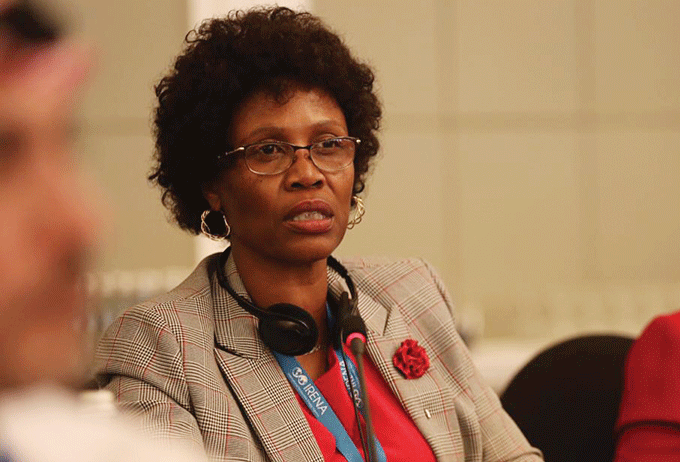
In an interview on the sidelines on the Zimbabwe National Chamber of Commerce (ZNCC) conference in Victoria Falls yesterday, Energy and Power Development Permanent Secretary Dr Gloria Magombo said the coming in of the Unit 7 and 8 in Hwange which are undergoing technical commissioning ahead of commercialisation improved the power situation.
Built at a cost of about US$1,5 billion, the Hwange Thermal Power Station Unit 7 and 8 expansion, is one of the Second Republic’s signature projects aimed at boosting power generation.
Unit 7 and 8 will provide a combined 600MW to about 1 400MW currently being produced from major thermal and hydro projects.
It is one of the flagship projects being implemented under the Second Republic in line with Vision 2030, which aims to transform Zimbabwe into an upper middle-income economy.
When fully commissioned, the project will help Zimbabwe reduce electricity imports and ease power cuts, which will drive increased industrial production as there will be guaranteed electricity supply, a key economic enabler and driver towards realisation of national goals in line with Vision 2030.
Before the expansion project, Hwange Power Station had an installed capacity of 920MW and the addition of 600MW from Units 7 and 8 will take the installed capacity to 1 520MW.
Dr Magombo said there are also a number of renewable power plants mostly solar being implemented by independent power producers and adding to energy sufficiency.
“We need to meet the growing demand which is based on the growing economy. As for Hwange Unit 7 and 8, from March this year we successfully synchronised Unit 7 which has been going through technical commissioning,” she said.
“We are now doing the last of the test and it will soon be going into commercial operation and as they are doing the tests the power is being supplied. And we have also successfully in May brought in Unit 8 which is now going through reliability tests and, it will go on until September when it will also go to commercial operation.”
Dr Magombo said during this period, the country will be having the additional 600MW.
“While there may be a day or two where we will be doing other tests, but it will be available and that is already being felt by people,” she said.
Dr Magombo said the date for commission of Unit 7 will be communicated in due course. At the moment, necessary invitations and process are being done.
“If you look at the additional 600MW which we have added onto the grid with all the two Units running, our current demand is sitting at about 1 850MW. We are now almost exactly supplying that amount, including some of the power which is coming from imports,” she said.
“Obviously you know that Kariba reduced output so we can do more in a year where there is much more water. So we are cautiously using Kariba now, but what we have is able to meet our demand and we are able to do without any load shedding.”
Dr Magombo said once Kariba returns to full capacity with good rains and repowering of Hwange Phase 1 and 2, the country might reduce imports or start exporting power into the region.
Presently, Kariba is filling gaps in energy supplies especially during peaks, with the energy mix almost 50/50 between thermal and renewable sources.
Dr Magombo said there is a significant number of private sector players who are providing energy solutions.
She said the country, however needs to do more with regards to actual access levels which are sitting at 62 percent.
About 90 percent of the population has access to lighting through solar energy.
Dr Magombo said Government also expects to add 2 000MW as additional capacity from gas as the country continues to appeal to the international world for funding to transition into renewables.
The Second Republic targets universal access to clean energy by 2030 in line with national vision of the attainment of an upper middle income society. – The Chronicle