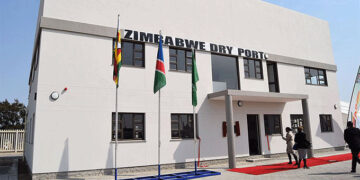




THE Zimbabwe dry port commissioned by President Mnangagwa at Walvis Bay in Namibia in 2019 to provide a strategic and cheaper gateway to the Atlantic Ocean to boost the country’s economy through enhanced international trade, has so far handled more than 385 cars coming into the country.
A dry port is a city away from a sea where formalities for exports or imports through the ports are completed and shipments sent from there to sea ports for loading on ships where no more paperwork is required.
The port allows Zimbabwean traders to be competitive in international markets by importing and exporting directly to Europe, West Africa and America using ocean cargo services.
The dry port was built on an estimated 19 000 square metres availed to Zimbabwe by Namibia on a 50-year lease.
Zimbabwe as an economy needed to focus on intra-Africa trade pitched by President Mnangagwa to attain an upper middle income economy by 2030 and Walvis Bay was the most obvious port for trade with the western side of Africa.
In an interview during the National Handling Services (Private) Limited annual general meeting in Harare NHS general manager (Dry Port) Mr Theodore Kundai Chinyanga confirmed the developments.
“The Zimbabwe Dry Port in Namibia is a facility that we were given by the Namibians on a 50 year lease. We started operations in 2019 and to date we have handled 385 cars. We also have a bond that we use for clearance and other agents that wants to use our facility that is there.
“So to-date about 1 553 bond entries that we have managed for the year 2022 but we have a capacity to grow up to 500 cars and also probably 3 000 bond entries the facility can handle that,” he said.
Mr Chinyanga said the bond entries happens were agents want to clear the goods or consignment.
“We have a bond with Namibian Revenue Authority, just like a clearing agents here, so our bond is a surety fee that whenever an agent default on acquittal, we are held responsible. So whatever that is coming to our yard as Zimbabwe Dry Port facility, its bonded its a bonded warehouse. Its kept safe until its cleared that’s the arrangement, we keep them on behalf of Namibian Revenue Authority until they pay all the dues and take the things out of the dry port facilities,” he said. – The Herald


