



BUILDING trust and retaining the confidence of business leaders or potential investors is certainly one of the challenging tasks for most policymakers or governments, and yet this is one of the cardinal indicators used to measure the impact of a serious political administration at any given time.
Given the heavy implications of business sentiment to overall development performance, the level of involvement and response by domestic businesses to the proposed policy framework tends to play a huge role in determining the success or failure of a country’s development goals.
The last five years have been packed with action in terms of industrial development as the Second Republic led by President Mnangagwa has scored major successes in transforming the productive sector through robust implementation of comprehensive ease of doing business reforms.
Keeping the 2018 election promise
In keeping with its election promise, the Zanu-PF government has managed to craft and roll out a vigorous programme to reform the Zimbabwean economy towards an upper-middle-income economy by 2030.
Underpinned by the political will and sovereign stewardship bestowed on it through the 2018 elections, the Government developed the Transitional Stabilisation Programme (TSP), which ran from 2018 to December 2020 and was to be followed by the second phase from January 2021 to
December 2025 (National Development Strategy NDS1), and the final phase running from January 2026 to December 2030.
The Zanu-PF Government has adopted a mixed economic model in which free enterprise is encouraged and rewarded. The expectation has been that of promoting a conducive business environment, which would be ultimately supported by strong social safety nets.
This, and other interventions, were meant to yield entitlements and or benefits that provide citizens and residents with a minimum level of a decent livelihood, food security, access to key public services infrastructure, education, and medical services to mention a few
Guided by such a deliberate and bold policy stance, Zimbabwe has been able to defy the tide of crippling illegal Western sanctions and unforeseen macro-economic challenges by increasing its domestic production and luring massive private sector investments, especially in manufacturing, ICTs, mining, and agriculture sectors.
Key industrial development manufacturing milestones
Zimbabwe’s re-industrialisation drive buttresses the broader domestic manufacturing rebound, which has seen capacity utilisation rising from 47 percent in 2020, to 56 percent in 2021 and to about 63 percent last year, according to the Confederation of Zimbabwe Industries survey, while shelf occupancy of locally manufactured goods has increased to about 80 percent in 2022.
The survey has also shown that at least US$101 million was invested into the country last year alone with companies expanding their capacity by up to 30 percent in 2022.
Developing a solid domestic industrial base is a top priority under NDS1, a critical building block towards the attainment of an upper middle-income economy vision by 2030.
To demonstrate his passion for industrialisation, President Mnangagwa has been visiting companies in Bulawayo and other parts of the country to engage and listen to challenges facing the country’s firms, and pledging more support. He has also expressed excitement about the re-industrialisation drive and commended private sector leaders for embracing innovation to drive their resuscitation.
As Zimbabwe gears towards the forthcoming harmonised elections on 23 August 2023, it is critical to reflect on how the productive sector performed in the last five years.
Among the major milestones has been the establishment of new businesses and the revival of several formerly distressed companies, which have been brought back to life through improved ease of doing business and facilitation brought about by President Mnangagwa’s administration.
Drawn from different sectors of the economy, the revitalised firms are now beefing up their production capacity through retooling and technology absorption in order to supply both domestic and export markets, in the process substituting imports while creating more employment opportunities for locals.
According to a recently-issued detailed report by the Ministry of Industry and Commerce, increased Government support and private-sector partnerships have stimulated renewed industrial investments in the last five years, mainly in the manufacturing sector where more focus is on value-addition and beneficiation. The report presents huge strides registered by the resuscitated businesses, which include key companies from Bulawayo, the Midlands, Harare, and other parts of the country.
Zambezi Tanners, one of the biggest leather processing and exporting players in Bulawayo has since increased its capacity utilisation to 80 percent and in terms of volumes, on the crocodile side, it is processing between 12 000 to 15 000 skins per year and 40 000 square feet for elephants annually. Recently the company launched a separate division that specialises in bovine finishing tannery and is one of the top exporters.
Bulawayo Provincial Affairs and Devolution Minister, Judith Ncube, has said noted in particular the strides being registered in the leather sector, which is contributing more to the restoration of Bulawayo as the country’s industrial manufacturing hub and widening of the job market.
Zimbabwe Leather Development Council (ZLDC) chairperson, Mr Clement Shoko, has said the country’s leather value chain success is linked to a roadmap to regaining its past glory of producing 20 million pairs of shoes annually and achieving greater competitive development in the form of “Zimbabwe Leather Sector Strategy 2021– 2030”
Another top Bulawayo company, Ref Air, which is into all large and small-scale refrigeration and air-conditioning supplies, repair, and installations is now on a solid business footing. The company recently bought new equipment and machinery worth US$400 000, which comprises two automated de-coiler machines, one spiller, and a blender.
During a tour of Bulawayo industries last November, a delegation of ambassadors to Zimbabwe expressed excitement over the gradual revival of the city’s companies and applauded the exports focus.
“We are inspired by the level of production, quality of products, and export capacity. We hope the industrial revival will spread to many sectors of the economy. Firms must urgently look into retooling to cut production costs,” said Zimbabwe’s Ambassador to Algeria, Vusumuzi Ntonga, who was part of the team.
From a background of closure of companies and loss of jobs experienced in the last two decades, the country’s second-largest city is now focused on revitalizing its key industries, guided by the value chain model.
National Foods Holdings Limited’s new mill at their Bulawayo site is set to increase wheat milling capacity by 2 000 tonnes per month. Other companies such as diversified Treger Group of Companies, Archer Clothing and United Refineries Limited, Sheppco BMA Fasteners, Metal Founders, Datlabs, Kango Products, Zambezi Tanners, General Beltings, and Arenel, to mention a few, are emerging stronger despite the Covid-19 and other economic constraints affecting the country.
To achieve more gains local firms are also pursuing strategic partnerships and seeking synergies with peers within the SADC region and beyond.
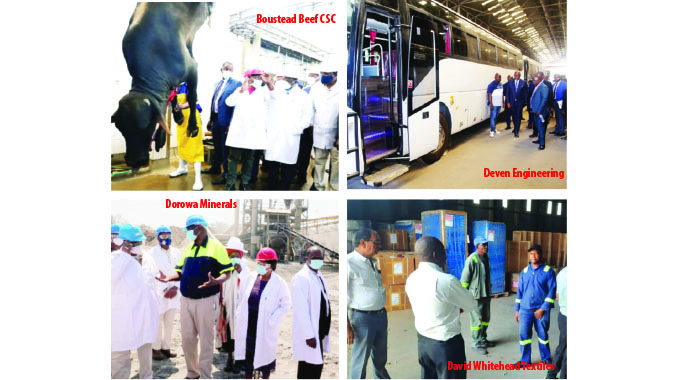
Similarly, the Government is nursing the revival of National Blankets, which was closed some years back and is now on its feet – being helped with retooling. Similar efforts have been made to boost the Cold Storage Company (CSC) through a deal with Boustead Beef, which culminated in the official re-opening of the giant beef processor by Vice President, Dr Constantino Chiwenga, last year.
Impact of positive Government support measures
The rapid expansion of industries characterised by the installation of additional lines of production is a direct response to Government support measures put in place to stabilise the economy and create a conducive business environment, Finance and Economic Development Minister, Professor Mthuli Ncube has said.
“On the development of industry, we are as a Government noticing that industry continues to expand. We are seeing established companies expanding their production lines. Generally, industries have benefited enormously from Government policies and are expanding,” said Prof Ncube in a recent interview.
“I think that the rate of growth of 2,5 percent for the industry that we predicted for this year might be an underestimate. The growth rate is right across the board and it’s impressive.”
The establishment of a US$1,5 billion iron ore mining and value-addition industrial park in Manhize, Chirumanzu District in the Midlands is expected to positively impact the country’s extractive and manufacturing sectors in a big way given the downstream benefits.
In Midlands again, ZimChem Refineries and Victoria Foods have become shining examples of the positive impact of the Second Republic’s economic reforms. Gweru-based Victoria Foods, a subsidiary of CFI Holdings Limited, which was placed under provisional judicial management in 2016, resumed its full operations in 2021 and has been operating satisfactorily since then.
Masvingo-based sponge iron producer, Simbi Company’s capacity has recently risen to 80 percent with output estimated at 3 000 tonnes with 116 workers.
The revival of Deven Engineering and Chemplex Corporation in Harare is another big win for Zimbabwe as the country repositions itself as a strong regional and global economic player.
With a focus on assembling semi-knocked down trucks and bus kits, Deven Engineering has recovered from lowest capacity utilisation of about five percent due to absence of off-take agreement from Government, to achieve 98 percent assembly project status completion.
Chemplex Corporation on one hand is a well-established group of strategic importance to the economy as a key supplier of agriculture, water treatment and livestock chemicals, while supplying mines and other key sectors.
The company’s revival has come in handy as it has assisted the country in fighting the January Disease and curbing teak-related livestock diseases through improved domestic supplies, said the ministry.
Through research and development, with support from the Industrial Development Corporation, Chemplex has developed a modern dipping chemical product that is now being exported to sub-Saharan Africa and has further developed the first-ever Zimbabwean-made cotton pesticide.
According to the report, Manicaland Province has not been left behind as three of its top companies are being assisted to recover and grow business returns.
Among these is the turnaround of vehicle assembly factory, Quest Motors, which produces buses, trucks and tractors as well as luxury vehicles but has been operating below optimum capacity with 102 employees. Phosphate ore reserves and magnetite operator, Dorowa Minerals is now undertaking an upgrade at one of its plants while awaiting equipment delivery from South Africa with financial support from the Treasury.
“The overall progress of the whole project is around 20 percent complete,” reads the report. Cicada Katiyo Estates, which produces avocadoes and macadamia nuts, has invested US$10 million to expand hectarage capacity and has created about 300 jobs with the potential to double the figure, said the ministry.
The relaunch of giant textile producer, David Whitehead in Mashonaland West, anchored on a retooling programme valued at about US$20 million is targeting to replace 90 percent of obsolete equipment.
In Mashonaland East, Hunyani has also beefed up its production in Marondera where it uses waste paper material to produce egg trays as part of waste management efforts and has 24 workers on two production shifts.
G&W Mineral, which is partly owned by IDC and operates from Mashonaland Central is working on setting up a limestone milling plant for both agriculture lime and high mesh worth three million with higher capacity to meet domestic needs.
Reflecting on these milestones Industry and Commerce Minister, Dr Sekai Nzenza, has said the changing business environment under President Mnangagwa’s “Zimbabwe is open for business” policy has had a spillover into the productive sector resulting in consistent and sustainable economic growth trajectory.
Technology absorption aided by enhanced input from the country’s universities and colleges, has also come in handy, including driving rural industrialization and innovation
Positive outlook despite challenges
The key concerns to the Government over the years and up to now have been the need to address the competitiveness of local industries and increasing access to capital to steer increased output for import substitution and widening export earnings.
With most manufacturing being realized in the informal sector, the Government has been seized with developing policies that can yield enhanced formalisation, re-tooling, and modernization of the local businesses through friendly fiscal and monetary policy including tax waivers for the importation of technology, machinery, and raw materials.
Access to short-term and long-term project finance, however, remains skewed in favor of mostly larger firms while SMEs struggle to access the same.
The country remains determined to attract global companies to establish factories in Zimbabwe through special economic zones, and leveraging its skilled labour to derive more positive gains.
Government has to deal ruthlessly with speculative market behaver to reverse the adverse impact of price escalation, and tame cartels and black-market players to ensure ordinary people enjoy the fruits of an economic turnaround.
Despite these bottlenecks and other macro-economic hurdles, analysts say the country’s industry revival momentum is a clear indication that the Second Republic is all about delivery. Under the astute and servant leadership of President Mnangagwa, driving increased production is a major transformative agenda towards Vision 2030.
Such a thrust means more employment opportunities and this is precisely what a government with the interest of its people does round the clock.
With the ruling party Zanu-PF tipped to clinch victory in the August polls, more positive prospects lie ahead for the country’s businesses as the Second Republic is more determined to consolidate the gains achieved so far. – The Herald


