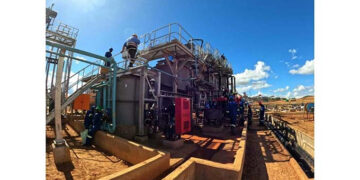




THE landing of Premier African Minerals’ Zulu Lithium in Pioneer Village, Fort Rixon, initially sparked scepticism within the community. The families were informed that their relocation was necessary to make way for lithium mining – a prospect that often faces resistance from communities that have sentimental attachment to their ancestral lands, especially when gravesites are involved. However, the approach taken by Zulu Lithium, centred on community engagement and support, managed to charm the locals, even leading to the exhumation of bodies buried within the designated mining area.
To address the concerns of the affected villagers, Zulu Lithium came up with an attractive relocation package, and already, five out of the 26 affected families have been successfully moved. The Pioneer villagers, beneficiaries of the Government’s land reform programme, had previously resided in modest pole and dagga houses. These structures were unfortunately ill-equipped to withstand the adverse effects of climate change. Zulu Lithium Mine decided to construct modern houses as part of the compensation package. Construction is still in progress but the first units are almost complete.
The construction of the houses is set to completely transform the beneficiairies lives as they will move from pole and dagga houses to modern houses that can withstand the vagaries of weather.
The mine is also providing additional social amenities for the relocated families. When Saturday Chronicle visisted the area recently, the villagers expressed their satisfaction with the ongoing development facilitated by the Zulu Lithium mining project.
Proccillia Sibanda, a mother of two, acknowledged the distress usually associated with relocating from one’s established residence. She however said from what they have experienced so far, the mine is promising a better future for the affected families.
“We were affected by the mine project, that is how we ended up here,” Sibanda explained while speaking from her new home, which is under construction.
“Our lives have significantly changed since we left the place where mining is now taking place. We were living in pole and dagga houses but now the company is building us modern houses.”
In addition to the improved housing, Zulu Lithium has pledged to pay school fees and transport for the affected school children until they complete their education. Sibanda said her husband is among the locals that have been employed by the mine.
Bongani Masango, Pioneer Ward 2 village head, said the first families to be relocated were those whose homes were where the mine is.
“The first five have been moved but we have 13 more who will be moved soon,” said Masango.
He said to ensure the affected famlies had temporary accommodation while their houses were being constructed, the mining company put up temporary wooden structures. Each family will have a four- roomed house, a kitchen, bathroom and toilet. Additionally the company will plough one-hectare for each faimly for just one season and also provide one tonne of maize.
“There is also a promise that each relocated family will be paid US$100 allowance every month for one year. Zulu Lithium will also pay school fees for all the children of the relocated families up to tertiary level,” he said.
The company has also drilled four boreholes that will be solar powered to guarantee the families reliable water source. Masango revealed that the company has also taken steps to address the community’s long-standing need for a dam. Construction of a new dam is underway that will enable villagers to grow crops under irrigation and water their livestock.
Breadwinners of most of the relocated families have been employed at the mine which is an additional package for the affected families.
Chief Jahana expressed his satisfaction with the project, emphasising the significance of communities directly benefiting from their natural resources. He said the modern houses being built for the affected families will improve the families’ livelihoods.
“Most of the villagers were living in thatched houses but now they have strong modern houses. The company also agreed that in future it will also install solar equipment in their homes as part of the modernisaton strategy. We agreed that in moving the people, certain terms have to be met for the 26 affected families and we are happy that the company is delivering on the promises,” said Chief Jahana.
Zacharia Jusa, the Insiza District Development Coordinator, underscored the importance of ensuring that the relocated communities are provided with better living conditions than they had before.
“We are saying in a way, we have removed you from the valued land and given you where there is no value in terms of minerals. It’s a way of compensating them, they have been here for years not knowing that there is a vast mineral underneath. So if you move them, you have to compensate them. You are actually keeping the mineral under them,” said Jusa.
“So, when you do that, you don’t need to give them what they had but give them bigger and better. That is why those who have an average of one room are being given four rooms and a kitchen plus water so that there is no more hassle in terms of getting the basics. It’s all in an effort to compensate and give value to what they have lost.”
He said there was a deliberate effort to ensure that even their children benefit from the project through provision of education.
“Depending on how that child performs in school, their qualification should see them employed at the mine. We are saying if you give them money they will tomorrow wake up with nothing. But it is better to give them what they can live on and sustain and it’s not about the parents only,” said Jusa.
The investment made by Zulu Lithium in the lithium plant is a substantial $80 million. Currently, the plant is undergoing a trial run and is expected to generate up to $30 million in revenue once the project reaches full operational capacity. This significant financial contribution not only bolsters the local economy but also ensures the long-term success and viability of the mining venture. – The Chronicle
- Latest
- Trending


