


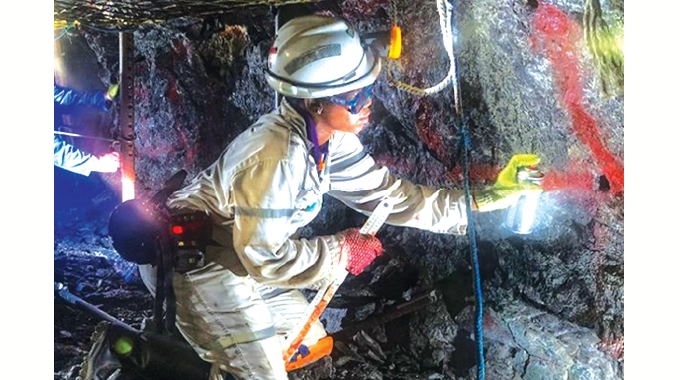
Women miners in Zimbabwe continue to make huge inroads in a sector that is traditionally male dominated and are contributing immensely towards one of the National Development Strategy 1 (NDS1) aspirations – employment creation.
The mining industry in Zimbabwe has been one of the major economic pillars estimated to be contributing 60 percent of the country’s export earnings. The sector covers 16 percent of the national Gross Domestic Product (GDP).
It is also estimated that women make up 10 percent of the 535 000 artisanal and small-scale miners in the country who made major contribution in national wealth creation.
Women Empowerment in Mining Zimbabwe (WEMZ) national director, Mrs Chiedza Chipangura, said a number of women have been involved in mining and this has improved many communities countrywide.
She said a sizeable number of women in mining business now exude with confidence as they have mastered the art of conducting the business.
“We now have a number of women being involved in the mining value chain from extraction, provision of services including value addition.
“Women are creating their own money and this has reduced issues of domestic violence because as a woman, when you are financially empowered, you can stand as a mother of the house,” she said.
She noted that from the grassroots level, there are women making as little as US$5 to US$10 per day. This, she said, was however making a huge difference as they are able to put food on the table and send children to school.
“We are grateful to the opportunities that the Government continues to give us and allow us to be involved in the mining value chain. These opportunities have played a part in the National Development Strategy 1 of employment creation,” she said.
Mrs Chipangura said there is a need for the Government to avail women empowerment initiatives such as training especially on equipment handling and the mining processes as well as managing finances.
“There is a huge gap towards the value chain and the Government should create training opportunities for women in mining so that they contribute more,” she said.
She indicated that in value addition, women should venture into manufacturing of mining equipment, such as hammers and other consumables critical in the sector.
Mrs Chipangura said the Government should also ensure when there are funds for mining like recently launched US$10 million facility, at least a quarter is reserved for women so that they can do more.
Recently, Finance and Economic Development Minister Professor Mthuli Ncube, launched the US$10 million gold fund targeting small scale and artisanal miners with half of it going towards loans and the other half to funding more processing and buying centres.
Artisanal and small scale miners contributed over half of the gold sold to Fidelity Refiners, constituting over 23,3 tonnes of the 35 tonnes delivered last year.
“We have also been encouraging women to formalise their operations, but the applications are lying idle in some provinces with other applications dating back to 2019.
“If the business is not formalised you cannot access funding and we can’t be running away from law enforcement agents every time,” she said.
The country is envisioning a US$12 billion mining industry by 2023. PGMs are expected to contribute US$3 billion with production expected to jump from about 979 000 ounces in 2018 to about 2, 5 million ounces annually in 2023.
Gold and diamonds will contribute US$4 billion and US$1 billion respectively, while chrome, iron ore and carbon steel will contribute US$$1 billion while coal and hydrocarbons will contribute the same.
Lithium – US$500 000, while other minerals will constitute US$1.5 billion.
The artisanal and small-scale miners (ASM) are also expected to play an important role towards the mining milestone with sector player’s committing to contribute US$4 billion by the targeted period.
Already existing mining players are engaged in various investments amounting to more than US$10 billion with some targeting first production this year.
The Government is targeting 100 tonnes of gold per annum by 2023. – The Herald


