


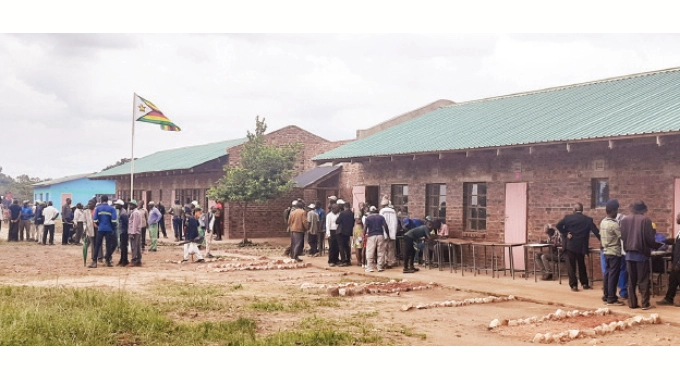
CHIDOBERA Primary School, built by Makonde Rural District Council using devolution funds, has been commissioned, a development that considerably reduces the distance walked by learners to school in the immediate area.
Mashonaland West Minister of State for Provincial Affairs and Devolution Mary Mliswa-Chikoka, who was represented by Permanent Secretary in her office Mr Josphat Jaji, commissioned the school on Tuesday.
The area legislator who is also Information, Publicity and Broadcasting Services Deputy Minister Kindness Paradza, senior Government and Zanu PF officials, attended the ceremony.
Construction at the $19 million school started in 2021 and was completed late last year.
Villagers, who also played their part in the construction of the school, said given its closeness to many communities, school dropouts would be limited.
In addition, child sexual abuse which was reported in the past due to the long distances walked by learners past bushy areas, are expected to be reduced too.
Mr Artinos Shumbaimwe from Chidobera Village, whose Grade One child endured her two-year heartbreaking Early Childhood Development period walking for 20km to and from the nearest school.
“This is an early Christmas present we have gotten from the Second Republic. Its opening has brought relief to me as a parent, considering how children have fallen prey to abusers,” said Mr Shumbaimwe.
Another elated villager, Mr Robert Murindagomo, said construction of the new school has reassured them that they will not be removed from their land allocated to them under land reform after opponents of the land redistribution lied that the villagers were illegally settled and were going to be removed.
With the school now open, villagers have pleaded with the Government to avail computers and internet connectivity to link Chidobera Primary School with the rest of the world.
Ward 8 Councillor Cde Paul Kisimusi said they now want to complete the construction of another teachers’ house, whose foundation has been laid.
Mobilisation of building material has been done and the community is eager to render any assistance requirement.
In her speech, Minister Mliswa-Chikoka assured the Makonde community that the Government would release more funds for infrastructure development.
“The state-of-the-art school which Makonde RDC has built is what the Government is pushing for to help bridge the rural-urban divide gap,” she said.
“President Mnangagwa is saying no place or person should be left behind in line with Vision 2030. The Government is going to release funds for the construction of more schools in Makonde district.”
Acting Provincial Education Director Mr Gabriel Mhuma said more teachers would be deployed to the school to reduce the tutor-pupil ratio.
“Deployment of more teachers to this and other schools is underway and only teachers from Makonde District are eligible to get positions as a way of reducing teacher turnover,” he said.
Deputy Minister Kindness Paradza, who has donated books for each child to last until end of this year, said while the school had brought relief to learners and the community at large, there was need for Makonde RDC to dedicate funds for the construction of more classroom blocks to cater for Grades Five to Seven.
The school is presently servicing learners from ECD to Grade Four.
Deputy Minister Paradza said collective work between council and the community had brought positive results.
Plans, he added, were in motion to connect the fully-furnished Chidobera Primary School to the national electricity grid, which passes through the area from Alaska to Kenzamba Business Centre.
Parents were challenged to play their part in developing the school by paying outstanding school fees.
“The Government is paying fees for our children this year. However, this is not a passport for parents to ignore debts that they have with schools,” said Deputy Minister Paradza.
Makonde RDC chairperson, Mr Simbarashe Ziyambi, said at least $300 million had been disbursed to the council by the Treasury under devolution funds.
Some of the funds have been dedicated towards provision of potable water, construction of clinics and more education infrastructure. – The Herald


