



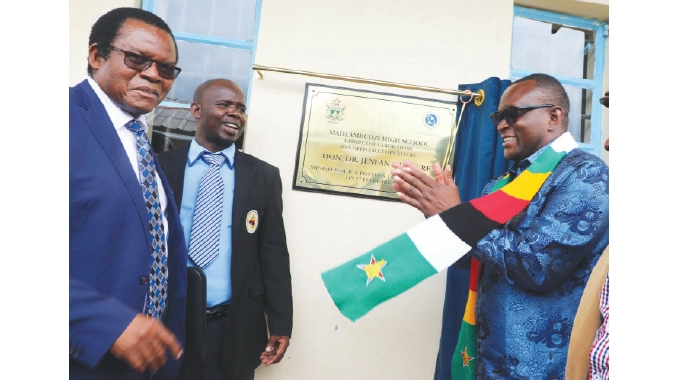
INFORMATION, Communication, Technology, Postal and Courier Services Minister Dr Jenfan Muswere and his deputy, Cde Dingumuzi Phuti yesterday commissioned computer laboratories at 15 schools in Matabeleland South province.
The computer laboratories were commissioned at Tjingababili Primary School, Osabeni Primary School, Vaka Primary School, Dombodema High School, Mnigau Primary School, Madlambudzi Primary School, Madlambudzi High School, Gwambe Secondary School, Manguba Primary School, Gambo Primary School, Makumbi Primary School, Tokwana Primary School, Tokwana Secondary School, Kungubo Primary School, and Ndolwane Primary School.
Speaking at Madlambudzi High School, Dr Muswere said the computer laboratories will connect the unconnected to the digital world and help develop the country as it moves towards attaining Vision 2030 through the Smart Zimbabwe 2030 Master Plan.
“Today is a fulfilment of the mandate given to our Ministry of ICT, Postal, and Courier Services to connect the unconnected to the digital age. We are thus here as disciples of His Excellency President ED Mnangagwa whose clarion call is to see Zimbabwe prioritise a digital economy in pursuit of Vision 2030. Our Ministry has documented its plan to attain Vision 2030 through the Smart Zimbabwe 2030 Master Plan,” said Dr Muswere.
He said the facilities will bring ICTs and related services within reach of previously marginalised and disadvantaged communities.
“For Zimbabwe to truly achieve Vision 2030, we must capacitate all our citizens with adequate ICT skills. There is no better place to start this training than within our primary and secondary schools.
“No nation can transform itself without first building the skills and capabilities of its current and future workforce. The facilities commissioned today are thus an important stride in building a new crop of ICT literate Zimbabweans in preparation for our attainment of Vision 2030.”
The commissioning of the computer laboratories is part of the National Development Strategy 1 (NDS1), which recognises that the creation of a digital economy will be key in the realisation of national priorities and overall socio-economic development.
NDS1 identifies ICTs as a key enabler of economic development and the entrenchment of ICTS across all national development strategies and as critical for the attainment of universal access by 2030.
Dr Muswere added that interventions to digitise Zimbabwe are not only limited to primary and secondary schools as they have many other programmes that include setting up community information centres, installation of base stations in areas with poor network coverage and equipping of public finance management kiosks.
Meanwhile, 57 laboratories have been commissioned under the programme since the start of the year countrywide.
Recently, 12 computer laboratories were commissioned at 12 rural schools in Matabeleland South. The schools commissioned with computer laboratories were Tshazi Primary, Stanmore Primary, Garanyemba Secondary, Ntepe Secondary, Selonga Secondary, Buvuma High School, Mkhalipe Secondary, Nhwali High, St Joseph Secondary, Vhembe High School, Majini Primary and Siyoka Secondary School.
Speaking at the same event, Primary and Secondary Education Minister Evelyn Ndlovu said the computers create resilience and long-term sustainability in education by making sure that no learner is left behind, especially in the aftermath of the Covid-19 pandemic.
“The provision of computer labs therefore, will avail access to online platforms for providing free education resources, positively impacting a whole generation of learners in Zimbabwe who could have otherwise been left behind,” said Dr Ndlovu. – The Chronicle


