



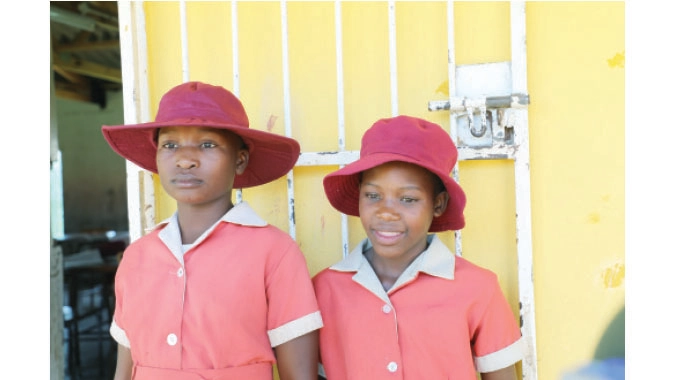
PRIVILEGE Maphosa a Grade Six pupil at Mbuyazwe Primary School in Umguza wants to be a doctor and walks 15km to and from school every day.
Two years ago, her dream seemed impossible as the pass rate at the school was a mere 5 percent. Fortunately, it jumped to 47 percent last year, giving her hope that her dreams could still be attainable.
Privilege attends a peri-urban school located along the Bulawayo-Tsholotsho highway about 20km from the city.
She lives at Red Bank Farm which is about 15km from Mbuyazwe Primary School and has ambitions to be a doctor when she grows up.
“I want to be a doctor when I grow up because I want to help people. I wake up at around 5.30AM and leave at 6.30AM and get to school at around 8AM. I make the journey with friends,” Privilege said during a tour of the school by the Ministry of Primary and Secondary Education and Unicef Zimbabwe to see the impact of the Schools Improvement Grant.
Mbuyazwe Primary School is part of over 4 500 schools across Zimbabwe that received the Schools Improvement Grant.
The school had been disadvantaged by two things: Covid-19-induced lockdowns and the lack of basic learning materials which resulted in 11 pupils sharing a textbook.
In 2020, the school recorded a 5 percent pass rate, a trend that threatened the pupils’ academic future and with it Privilege’s wish to be a doctor.
The Ministry of Primary and Secondary Education, in conjunction with Unicef Zimbabwe, came in with a Schools Improvement Grant (SIG) to fund disadvantaged primary and secondary schools.
The funds are used to cover non-personnel and non-capital resource demands to enable schools to cover their most basic needs.
The grant was made possible thanks to the Education Development Fund (EDF), a multi-donor pooled funding mechanism supported through aid from the UK Government and the German Development Bank (KfW).
The EDF enables donors to jointly support the Ministry of Primary and Secondary Education in its activities, with Unicef managing the funds and providing technical support.
Through the SIG, Mbuyazwe Primary School bought textbooks for pupils that helped improve the Grade Seven pass rate from 5 percent in 2020 to 40 percent in 2021 before climbing to 47 percent in 2022 according to school authorities.
The authorities hope that the pass rate will continue going up.
Privilege said learning has been better especially in the past two years and her dream to be a doctor might come true.
“The textbooks that were bought for us have really helped in our learning. Now rather than us sharing textbooks amongst the four of us, we have in some subjects one each while in others we share in pairs. This has improved our learning and also in addition to the furniture that has improved our experience in the classroom,” said Privilege.
Her classmate, Grace Banda, who wants to be a nurse, said learning conditions have improved.
“Now we have in some subjects one textbook each and this is good for me in my learning as I want to be a nurse when I grow up.”
Mbuyazwe Primary School headmistress Mrs Silobile Masuku said she was pleased to see a steady jump in the pass rate which she attributes to the provision of textbooks through the SIG fund received in 2021.
“The Grade Seven pass rate has improved a lot. There was a time that the pass rate was as low as 5 percent. From 5 percent it rose to 40 percent in 2021. Just last year the pass rate went up a bit to 47,5 percent. That is a plus, because learners have access to teaching and learning material and this helps teachers as they plan their work and the learners are able to utilise the textbooks that they have,” she said.
“Besides the textbooks we have managed to buy furniture and all our classrooms have enough furniture for the pupils. I’m told that around the year 2009, before the grant, the situation was very bad. There were no textbooks and furniture, and learners would sit on the floor.”
Although there are successes scored by the programme, Mrs Masuku said the school is still facing constraints as over 75 percent of the pupils’ parents cannot afford to pay school fees.
“The default rate is between 75 and 80 percent. Most of the parents of the learners are farm workers who depend on piece jobs to make ends meet. So, they will tell you that they can’t pay school fees and the like. We can’t put everybody on BEAM as it specifies the number of learners it can accommodate. Then those who remain, you find that they aren’t paying fees and we charge a levy of US$20 or its equivalent as per bank rate,” said Mrs Masuku.
She said there is a high staff turnover and that causes challenges at the school.
“Our challenge here is that because it’s peri-urban and our school is classified as Bulawayo urban, most of the people come here en route to the city centre. So, every term or year, teachers will be moving on, so the staff turnover is just too high,” said Mrs Masuku.
Her deputy Mrs Judith Sibanda said there is still a need for Arts, Heritage Studies and Physical Education textbooks which are in short supply.
“We bought textbooks across all grades from ECD right up to Grade Seven. Before the ratio of books to pupils was either one to 10 or one to 11, but this time the ratio is one to two. This means we have about enough textbooks and we can just add a few. This helped us a lot,” said Mrs Sibanda.
“However, subjects such as Arts, Heritage Studies and Physical Education are still in need as that’s where there’s a short supply. We appeal to Government and the development partners to help in this regard.”
Ministry of Primary and Secondary Education director of communications and advocacy Mr Taungana Ndoro thanked the development partners for their collaboration with the Government in providing quality education, especially at underprivileged schools.
Last year, Government declared zero tolerance to zero pass rates in any school, particularly those in rural areas. – The Chronicle


