



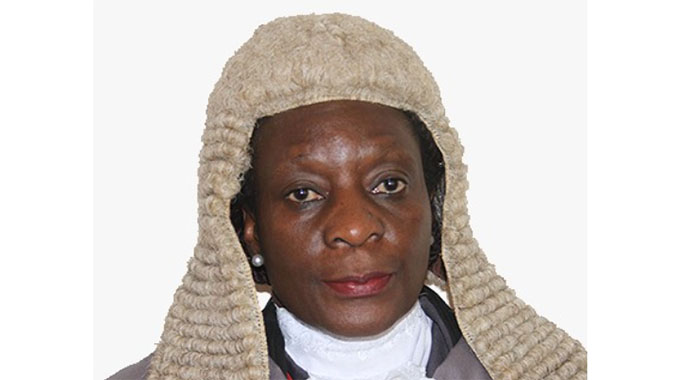
TRADITIONAL leaders have been warned against allowing communities within their jurisdictions to marry-off children with Constitutional Court judge Justice Rita Makarau saying the apex Court had spoken loudly and clearly against child marriages.
Chiefs and other traditional leaders had the dual role of preserving and interpreting culture, and managing the cultural changes required when the law changed.
Justice Makarau cautioned traditional leaders, in their capacity as marriage officers of customary marriages under the new Marriages Act, never to solemnise marriages of children even when there is consent from parents or guardians.
Officially opening the 2023 High Court Legal Year at the Masvingo High Court yesterday, Justice Makarau noted that traditional leaders should be able to draw the line when constitutional provisions must take over age-old cultural practices and traditions in their domains.
“When and where to draw the line is a minefield that traditional leaders must navigate with utmost care,’’ said Justice Makarau.
“For judges who interpret the constitution daily, the correct approach to adopt in the given situation is clear and easy. The point to be made and one which dovetails with the theme of the 2023 legal year is that all effort must be made to assist the traditional leaders to know when the law and custom and culture are in conflict and when they are not.
“The chiefs’ council, members of academia, the judiciary, the Judicial Service Commission and its training arm, must all come together to enhance competent service delivery by our traditional leaders in the application of customary law in tandem with the constitution and other statutes”.
There was a need for traditional leaders to undergo training on the intricacies and inter-marriages between their role as custodians of both the law and culture to enable them to discharge their duties well.
“The Constitutional Court has spoken loudly and clearly against child marriages. Traditional leaders live with the majority of our populace and by extension, live with the majority of children. It falls squarely on their shoulders to protect these many children from early purported marriages,’’ Justice Makarau said. She gave an example of a situation where culture and the law clashes in which a girl child is given by the family of an offender to atone for the death caused by the latter which is an age-old cultural practice in some areas but cautioned traditional leaders to always make sure they protect the girl child as laid down in the Constitution.
The Constitutional Court Judge, however, praised traditional leaders for the role they play in the justice delivery system as the primary stage of interface between the law and the litigating public.
Turning to this year’s harmonised elections Justice Makarau added her voice to growing calls for the polls to be violence-free saying while contest can be robust, there was no need for players to resort to violence.
Zimbabwe’s electoral laws, while not perfect, said Justice Makarau, were robust enough to ensure fair play for all contestants ‘’without the need to resort to violence’’.
“We further applaud the calls that have hitherto been made for peaceful and violence-free elections. We add our very small voice to that call. We firmly believe that while political contestation must be robust so that the best candidates emerge and are voted into office, violence or threats of violence have no place in that contestation.’’
Justice Makarau lauded some leaders of some of the political parties that will contest this year’s polls for speaking out against violence and called on Zimbabweans to heed such calls.
“We further implore and encourage all contesting candidates at all levels to accept the results of the poll as a reflection of the will of the people. Whilst the judiciary will have in place the requisite machinery to determine all poll-related disputes from political violence offences to election petitions, it is however our sincere hope that none of these arrangements if needed at all, will be put to more than minimum use in the forthcoming elections.’’
She also heaped praise on Government and other stakeholders for ongoing preparations underway for the harmonised poll to be held this year as dictated by the constitution.
Before the official opening, a moment of silence was observed in honour of the late High Court judge Justice Elijah Makomo who passed on last month.
Present at the official opening of the legal year in the Masvingo High Court were the two resident judges, Justice Garainesu Mawadze and Justice Sunsley Zisengwe, senior Government officials, lawyers and traditional leaders led by chiefs’ council president Chief Fortune Charumbira.
After the event, JSC secretary Mr Walter Chikwana addressed Masvingo legal practitioners on the commission’s second phase of the Integrated Electronic Case Management that will see the Labour and Administrative Courts going paperless with effect from February 1, this year.
Lawyers interested in litigating in the digital courts were also registered during the event addressed by Mr Chikwana.
The opening of the legal year at Chinhoyi High Court was presided over by Judge President Mary Zimba-Dube.
The Judge President, who highlighted successes achieved by the Judicial Service Commission (JSC) including the setting up of a National Council of the Administration of Criminal Justice, said the JSC will guarantee respect and protection of accused persons.
The council, she said, will operate without impinging the independence of stakeholders.
She said there was a need to deploy another resident judge at Chinhoyi High Court.
The court is manned by one resident Judge, with reliefs done by two Harare-based Judges attending to rising murder and robbery cases.
Chinhoyi High Court has 41 pending cases from 1 515 received last year. – The Herald


