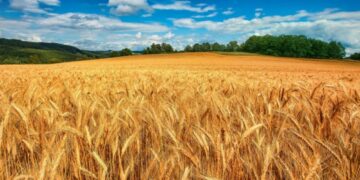




ZIMBABWE has written its name in the annals of history in the continent becoming one of the only two African countries that are wheat self-sufficient as Government’s agriculture transformation strategy starts bearing dividends, a Cabinet Minister has said.
President Mnangagwa launched the US$8,2 billion Agriculture and Food Systems Transformation Strategy in August 2020, whose aim was to eliminate food imports and make the country food secure while increasing employment in the sector.
The strategy aims to diversify exports while uplifting rural livelihoods as the country journeys towards an upper middle-income economy by 2030.
Within the first two years of operationalisation of the strategy, Zimbabwe has started recording unprecedented success, making the Cabinet committee on imports redundant as the country has been able to eliminate grain imports while achieving national food security.
Government has committed more financial resources towards the radical transformation of the agriculture sector.
This year, Government will introduce a two-wheeled tractor to replace ox-drawn plough and hoe as it moves to mechanise agriculture.
The country will also increase the hectarage of irrigable land to reduce dependence on unpredictable rain-fed farming.
Speaking during a National Thanksgiving and Dedication Service held in Bulawayo last Friday, Lands, Agriculture, Fisheries, Water and Rural Development Minister Dr Anxious Masuka said Presidential strategies to transform the agriculture sector have started producing results.
“Let me talk about some recent success by the President, you probably know that Zimbabwe was joined by Ethiopia, only two weeks ago, as the only two African countries that are self-sufficient in wheat. Yes, for the first time in the history of the country we have produced 375 000 metric tonnes of wheat, enough for our requirement for 13 months,” said Dr Masuka.
Zimbabwe requires 360 000 tonnes of wheat annually and for years the country imported wheat from Ukraine.
But the Russian-Ukrainian war escalated the need for nations to become self-sufficient as the war affected supply chains and increased the price of wheat.
He said the climate-proofing agriculture methods such as Pvumfudza/Intwasa programme which now supports 3,5 million rural and peri-urban farmers the country has dealt away with grain imports.
Dr Masuka said the country has adequate stocks to last the country into the next harvest season.
“When we climate-proofed agriculture at household level, In the 2020/21 season we produced 2,9 million metric tonnes of maize, the highest the country has ever produced. Last year, because we had the mid-season drought, we produced 1,5 million metric tonnes but we had enough in the strategic grain reserve to assure this country,” said Dr Masuka.
“As of yesterday, let me just give you the statistics of what we have at the Grain Marketing Board we have 451 761 metric tonnes of maize, we, currently at GMB depots, have 760 920 metric tonnes of traditional grains, cumulatively 508 681 metric tonnes enough to last the country until the next harvest. Now Zimbabwe is food secure, this is the vision of the President in action.”
He said as the majority of citizens are rural-based, Government is implementing agriculture projects that seek to uplift the rural communities from subsistence farming to surplus-oriented farming.
Dr Masuka said President Mnangagwa believes that rural development through agriculture is the bedrock through which Vision 2030 can be attained.
He said several interventions have been put in place to increase productivity of rural communities.
The Minister said President Mnangagwa has launched the poultry, goats and cotton and teak grease programme as part of the strategies to ensure that rural communities are involved in the economic development of the country.
“His philosophy is that agricultural development would lead to rural industrialisation. Rural industrialisation would lead to rural development and rural development would cause economic development that would power our nation towards vision 2030. It is agriculture that is at the epicentre of this transformative journey towards vision 2030 which His Excellency has clearly articulated,” said Dr Masuka.
He said Government is in the process of revolutionising the country’s farming through procurement of mini-tractors.
“The biggest challenge is that at small holder level, the ox-drawn plough and hoe are the biggest limiting factors to increasing production and productivity. So, the President has directed that we avail two- wheel tractors in villages and we will start this next year (this year.)” said Dr Masuka.
“This year alone we have distributed over 1 600 tractors. Ordinarily the private sector sells about 500 tractors per year. Government has just secured a supply of 3 337 from Belarus and these will be arriving from May 2023 for distribution to farmers. This is unprecedented in the history of the country.”
He said the country’s food demand is not connected to rain hence President Mnangagwa’s directive that more land be irrigated.
Dr Masuka said linked to irrigation programme is the construction of water bodies hence Government is in the process of constructing 12 high-impact dams including Lake Gwayi Shangani.
“In terms of irrigation development, the President has a very ambitious programme. He has directed 350 000 ha be put under irrigation by 2025 currently we have 187 000 ha so whether it rains or not, we will have enough to feed the nation. These are the transformative interventions as the President says no one and no place needs to be left behind,” said Dr Masuka.
He said the flagship of the Presidential intervention programmes include restoring the dignity of women and girls through availing clean water to communities through drilling of boreholes.
Dr Masuka said vision 2030 cannot be achieved when women and girls walk long distances to fetch water.
He said Government has secured borehole drilling rigs to ensure that each of the country’s 35 000 villages has access to clean water.
“We now have received 16 drilling rigs out of the 80 that Zimbabwe National Water Authority will be utilising and just under 500 villages have been covered and we will be accelerating this drilling programme,” he said.
Dr Masuka said through the provision of water to communities, Government will also start village horticulture gardens and fisheries to enhance food security at communal level.
“The President has said each of the 35 000 villages would have two fish ponds and we have already launched this in Mangwe District, Matabeleland South last year.” – The Chronicle
- Latest
- Trending


