


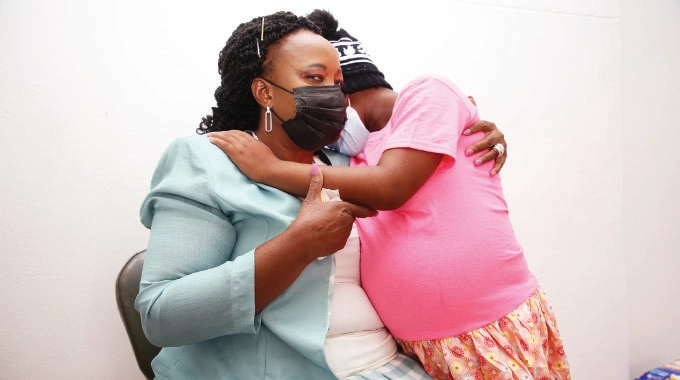
NEWS of a 13-year-old boy from Tsholotsho who impregnated his nine-year-old cousin shocked many. Initially, the girl’s father was suspected of having raped her.
However, deoxyribonucleic acid (DNA) tests at the National University of Science and Technology in Bulawayo concluded that the girl’s cousin, and not her father, was responsible for her pregnancy.
A few weeks after the Tsholotsho story broke out, it was reported that another nine-year-old girl who resided on a farm in Bindura was six months pregnant, after being allegedly raped by two 17-year-old brothers from the same place.
The girl, a Grade Three learner, was admitted to the Bindura Provincial Hospital and has been under the care of the Social Development Department.
The Zimbabwe Republic Police recently announced that it was investigating a case in which a 13-year-old girl was raped at a workshop in Chitungwiza.
The girl is now four months pregnant.
In May, a four-year-old Harare girl was raped by a boy aged 11. The victim and the abuser were co-tenants.
A worrying phenomenon
In recent months, there has been a notable increase in the number of child-on-child sexual abuse cases.
The Tsholotsho incident in particular has helped put such cases on the radar.
Child-on-child sexual abuse involves a child being sexually abused by one or more other minors.
In this type of sexual abuse, adults are not involved.
According to Mrs Petronella Nyamapfene, the team leader of the Justice for Children Trust, an organisation that protects the interests of children, there has been a noticeable increase in the number of cases in which minors are indulging in sexual activities.
“At the moment, I cannot give you the actual statistics since we are in the process of compiling them. However, what I can say is that a lot of our young people are engaging in sexual activities among themselves.”
Mrs Nyamapfene said this is a worrying phenomenon. She further said parents and guardians should accept the fact that some minors are now becoming sexually active at a very tender age.
She urged parents, guardians and society at large to provide sexual abuse victims with moral and financial support.
“Whether we like it or not, children are now frequently engaging themselves in sexual activities. This is the reality on the ground. All we need to do as communities is to help and support both the girl and boy child,” Mrs Nyamapfene said.
Social media to blame?
Social commentator Dr Rebecca Chisamba attributed child-on-child sexual abuse cases to a number of factors.
She said some parents and guardians are not monitoring their minor children’s activities on social media platforms, resulting in them being exposed to sexual behaviour.
“Child-on-child sexual abuse can be attributed to a number of factors, with the social media being one of the major drivers. The erosion of cultural values is also contributing to this scourge, as the extended family is no longer recognised by some,” Dr Chisamba said.
Unlike in the past, she added, sex is now being openly discussed on social media platforms, which are easily accessed by children.
“Traditionally, sex was not a subject that was discussed openly. Today’s youths often discuss sex openly. Most youths view sex as a form of entertainment,” Dr Chisamba explained.
This early exposure to sex, according to Dr Chisamba, is helping to fuel child-on-child sexual abuse.
Blessed Chinyangare, a psychologist, said social media and the way children are being brought up is contributing to the rise in child-on-child sexual abuse cases.
“Minors-who are naturally curious, are being exposed to social media programmes in which sexual activities are openly discussed. Curiosity drives the minors to experiment and indulge in sexual activities,” Chinyangare said.
Chinyangare said cases of child-on-child sexual abuse are often difficult to handle.
“In most cases child-on-child sexual abuse cases involve close family members. Because of the close family ties, such cases are often not openly discussed,” added Chinyangare.
Chinyangare urged parents and guardians to monitor their children and to support the victims.
“As they say, prevention is better than cure. Parents and guardians must maintain close relationships with their minor children and should be open enough to share and discuss any issues,” Chinyangare said.
He said both the victims and perpetrators of child-on-child sexual abuse must be given psychological support.
Monitoring minors critical
She proffered possible solutions to the scourge.
“We need to put all hands on deck and go back to the drawing board. We need to teach our children about the dangers that are associated with sex. We also need to monitor what our children follow on social media,” Dr Chisamba suggested.
Mr Michael Mbambo, a sociologist, attributed child-on-child sexual abuse to poverty, lack of parental guidance and the erosion of cultural values, among other factors.
“The social media is a major contributor, and so is poverty. We have children who are sharing their bedrooms with their parents.
“We also have child-headed families in which the minors are not supervised at all. The children might end up being exposed to sex at a tender age,” Mr Mbambo said.
Sekuru Mutasa (born Bright Mharadze), a traditional healer, attributed the rise in the number of child-on-child sexual abuse cases to the erosion of cultural values and the modern diet.
“The type of food that we are taking these days makes some of our children sexually active at a tender age. Also, the extended family is not being respected, resulting in close relatives, especially the younger ones, getting into incestuous relationships,” Sekuru Mutasa said.
Cases collapsing
A lawyer, Mr Fungai Chiwara, said some parents and guardians are fuelling child-on-child sexual abuse cases especially among those in early teens.
“Some families are failing to stomach the fact that their children are engaging in sex. After discovering that the girls have engaged in sex and got pregnant, some family members will influence their children to report consensual sex as rape,” Mr Chiwara said.
According to Mr Chiwara, rape cases in which children are coached to falsely accuse innocent boys usually collapse during court sessions.
“In most instances, the girl will exonerate the boy in court. The girl will tell the court that the sex was consensual and that she was forced by her parents to report the case as rape,” added Mr Chiwara.
Government interventions
Public Service, Labour and Social Welfare Minister Professor Paul Mavima said Government had put in place mechanisms to deal with cases of child-on-child sexual abuse.
The Government, through his ministry, offers specialist child protection services and therapy for the children and families for them to cope with the situations.
“When faced with such cases, the ministry collaborates with other line ministries such as those of Health, Education and Justice. We have a well-structured and systematic plan that puts the best interests of the children at the fore,” said Prof Mavima, who was responding to questions regarding the pregnant Tsholotsho girl. – Sunday Mail