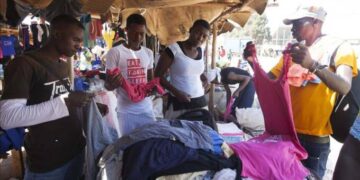




SMALL retailers, also known as runners, have changed the game on the local market if recent shopping trends are anything to go by.
The festive season has over the years been characterised by many making a beeline for the borders to buy foodstuff and fashion for Christmas and New Year celebrations.
Likewise, Zimbabweans based in the diaspora, particularly South Africa and Botswana, would be stampeding to return home — often with an assortment of groceries and clothing for their friends and relatives.
But it appears that is not the case this time around. It appears the public no longer finds logic in travelling outside the country for bargain hunting.
Everything is now readily available at home, and, in some instances, at much affordable prices.
“By this time, in previous years, bus companies would be overwhelmed, as most people travelled to neighbouring countries for Christmas shopping. But business is still low. Runners import almost everything, including groceries, so most people feel it is better to buy from them because their prices are low.
“Also, this year, there are few people travelling to Zimbabwe for holidays and most of them feel that it has become cheaper to buy groceries here (Zimbabwe). Those making use of our services are traveling without much luggage,” said Guidance Gandashanga, a cross-border bus conductor.
Runners are selling a wide range of merchandise such as clothes, shoes, kitchenware and groceries.
The bulk of their stuff is sourced from South Africa, Zambia, Tanzania, Dubai, China and Turkey, among other places.
Harare’s Central Business District used to have a few shopping malls, among them Eastgate, Joina City and the now-defunct Ximex Mall.
However, today, they are all over.
Most spacious buildings in towns and cities are slowly giving way to shopping malls, with the owners subdividing their properties into smaller rental spaces.
The space is being rented out to people specialising in different trades. These spaces are being used as grocery stores, boutiques, salons, garment-making premises and massage parlours, among other businesses.
Only a handful of cross-border traders still use their car boots for business.
Many argue this could be the reason departmental stores have either shut down operations or are sinking.
Runners usually have their stuff pegged at lower prices. Moreover, they are open to negotiation and take specific orders, which naturally attract customers.
Their flexibility is probably due to the fact that they pay less in rent.
Feeling the heat
Competition from cheaper products offered by smaller retailers has seemingly been too much to handle for most giant retail outlets.
Established businesses are not the only ones affected. Second-hand clothes (mabhero) traders are also singing the blues.
Used clothes are usually imported from the United States, and have, until recently, been on high demand.
However, an influx of cheaper and brand-new products from the Asian market and other African countries, coupled with a ban on second-hand clothing, has created challenges for old clothes traders.
Victor Mharapara, who sells second-hand clothes at a mall adjacent to Delta’s Graniteside soft drinks plant in Harare, is not a happy man.
“Business has declined significantly. Most people now prefer new and cheaper stuff from runners,” he said.
For a pair of sneakers, Mharapara charges between US$30 and US$45. The same amount can buy two or three new pairs from runners.
He gets his merchandise from the Democratic Republic of Congo, where he travels by truck once in a month or two.
“Before 2019, I would travel twice or thrice a month. The stuff was on demand then, but now, apart from finding it hard to transport the bales due to the ban on mabhero, competition from runners is also driving us out of business,” said Mharapara.
“The few customers I still get are attracted by quality since I sell original stuff.”
At the Eastgate Shopping Mall, Chenai Zimbeva, a denim wear dealer, is equally worried. To withstand competition from runners, she has now been forced to be creative with her old clothes.
Zimbeva washes and irons the stuff, and sells it from shop shelves.
She also adds artistic designs to the products. Her jeans are pegged at US$10 a pair, with denim shirts going for US$7. But within the same vicinity is a runner with new jeans and shirts that cost as low as US$8 and US$3, respectively.
“I advertise on social media and largely rely on clients I get online. Walk-ins are now very few. I sell original jeans from Canada but I get them from dealers in Mozambique. Naturally, most people prefer cheaper stuff, so I have to be patient. The situation was better when we were still competing only with retail giants,” said Zimbeva.
Uptown giant boutiques are equally feeling the pressure.
“Our stuff is almost the same and we have similar sources. However, our prices are higher due to rentals,” said Vivian, a boutique owner.
She said they pay rent ranging between US$800 and US$1 000. Runners operate from small sublet spaces that are at times as low as US$250 in rent.
“Apart from runners, others prefer buying from established retail outlets that have credit facilities,” notes Vivian.
Charity Mudzamiri, a primary school teacher, said credit facilities were convenient.
“Shopping through a credit facility relieves me of pressure as I am able to save money for my children’s school fees. Besides, I think the stuff sold by runners is not only cheaper but also of poor quality. Second-hand clothes actually have better quality,” argued Mudzamiri.
Shift
It is generally believed that the Covid-19 pandemic, which forced most countries into lockdowns, changed the business routine in the country.
With travel restrictions in place, dealers had to devise ways of getting stuff from different countries without travelling.
Online purchase became the order of the day, while others resorted to using exempted long-distance truck and bus drivers to import their stuff.
“It all happened through social media. We connected with ‘agents’, most of whom are Zimbabweans resident in South Africa,” said Ethel Mambare, a runner.
“The agents would send us price guides and pictures of products available. We would then collectively send them cash through money transfer agents. The figure covered the cost of the stuff, agent fee, transport and duty. Back home, we would request our clients to pay a deposit as commitment to ordered goods,” explained Mambare.
Truck drivers are currently enjoying ‘brisk business’, with some pocketing at least US$400 per trip through side hustles.
“The agreement with the client is that I pay full duty for all items sent through me. The owner of the goods should cover all the costs, including transportation,” revealed Cuthbert Simango, a cross-border truck driver.
Unlucky
Dennis Ndebele was recently left broke after he unknowingly got a bale that had poor quality shirts.
“This is one of the risks associated with dealing in second-hand clothes. I sold some of my assets to raise capital for this trade. I then bought a sealed bale from a dealer in Mbare for US$250. Sadly, most of the stuff was either torn or of poor quality. I struggled to recover my investment,” lamented Ndebele.
However, some runners have also been unfortunate.
Norbert Ngwenya was early last year linked to a Dubai-based wholesale supplier of apparel by a friend.
Orders were done online.
He initially sent her US$500 and the consignment was delivered.
After successfully selling the stuff, Ngwenya sent US$750 for more merchandise, which, unfortunately, was never delivered.
The supposed agent vanished without a trace.
“Since then, I no longer do business online. I either travel to South Africa or Zambia every week. My prices are low and my stuff sells fast. For instance, I sell jeans for US$8 and US$10 depending on the designs and quality,” said Ngwenya, who operates at Margolis Plaza.
Remedy
The local textile and clothing industry is grappling with a lot of challenges, chief among them the influx of cheap fabrics imported from Asian markets and smuggled second-hand clothes.
Experts opine trade liberalisation, which comes with the opening up of markets, created unfavourable competition.
One of the country’s biggest lint processor and textile manufacturer, David Whitehead Textiles (DWHT), told The Sunday Mail Society that plans were afoot to revamp operations.
“We are in the process of installing new equipment and repairing some old ones as we count down to starting operations next year. However, there is a need for Government to come up with structures that protect the local industry from cheap imports through reviewing import tariffs and enforcing bans,” said the DWHT Communications Department.
An official from a local clothing manufacturing company weighed in.
“We need more punitive measures to deal with people who smuggle second-hand apparel or even new clothes. We also need the law to be tough on those caught dealing with such products on the market if we want our textiles industry to recover. We can never compete with smuggled goods.”
The textile and clothing industry, at its peak, used to employ over 40 000 workers but the figure has significantly plunged.
The Government, through the National Development Strategy 1, identified the sector as one of the country’s key value chains.
Industry and Commerce Minister Dr Sekai Nzenza revealed that the Government is working on a cotton-to-clothing strategy which will be launched soon.
“Under the NDS1, cotton-to-clothing is one of the priority value chains. Government is strengthening this value chain by ensuring increased cotton production through the Presidential Input Scheme. The cotton-to-clothing strategy will provide further support incentives for the textile industry. Statutory Instrument (SI) 122 of 2017 also protects the local textile industry from the influx of second-hand clothes,” said Dr Nzenza.
She added that the Government also regulates the importation of all uniforms to ensure increased local textile manufacturing. In addition, Treasury has also allocated US$5 million for the textile industry under the US$22,5 million Special Drawing Rights (SDR) Retooling for New Equipment and Replacement under the Value Chain Revolving Fund (REVCRF).
“Government is attracting new investment into spinning and ginning through the provision of various incentives including manufacturers rebate and value added tax (VAT) deferments.”
The local manufacturing sector currently contributes 13 percent to the gross domestic product GDP.
“Concerted efforts are being made to deal with the challenge of smuggling of second-hand clothes through the porous borders. Vision 2030 projects that increased use of ICT, innovation, technological advancement, research and development will boost productivity, competitiveness and efficiency levels in the manufacturing industry.
“This will result in a diversified and competitive manufacturing sector that will be the key driver of economic transformation, from a largely commodity dependent economy to a knowledge driven secondary and tertiary economy,” added the Minister.


