


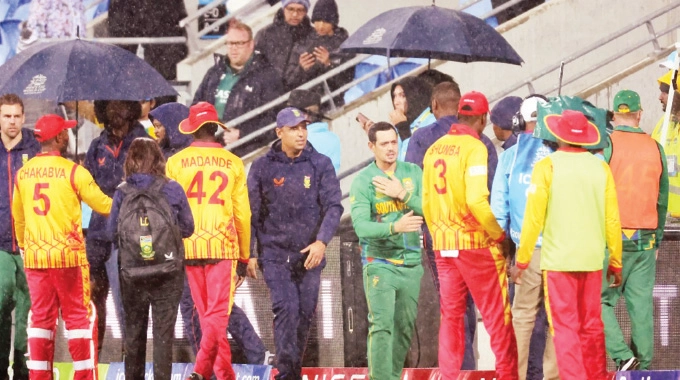
IN the end there was no result.
But it was a huge relief for the Zimbabwe national cricket team when the much-anticipated Southern African Derby against the Proteas of South Africa at the ICC Men’s T20 World Cup was called off due to rain yesterday.
The umpires were forced to call off the game after the conditions of play had become dangerous due to the persistent rains and the wet conditions at the Bellerive Oval in Hobart, Australia.
The game suffered several disruptions on the night and the umpires had to make a final call just as South Africa were charging towards the revised target of 64 runs to win, from seven overs.
But as the rain intensified, it became increasingly dangerous to play, with Zimbabwe’s left-arm quick Richard Ngarava slipping and injuring his thigh in his follow through.
Zimbabwe subsequently elected to bowl spinners, seemingly to protect their pace bowlers from potential injury.
Wicketkeeper Regis Chakabva also slipped as he moved down the leg-side.
The conditions were far from ideal but the umpires felt the game somehow had to continue in order to get a result despite the protests from some Zimbabwe players
A minimum of five overs are required in a run chase to constitute a game in T20I.
By the time the game was called off, South Africa had faced three overs and made 51 runs for no loss of wicket. They needed 13 runs from 24 balls to win.
But Zimbabwe head coach Dave Houghton felt the game should not have taken place at all because of the bad conditions. He told reporters during the post-match interview that the game got to a point where it was “ridiculous” to continue playing.
“I understand the need to try and get these games on for the public and TV people and to play in slightly inclement weather to try and get a result, but I felt we overstepped that mark,” Houghton was quoted by BBC Sport.
“I don’t think we should have even bowled a ball to be honest, but the umpires are the guys making the decisions out in the middle and they seemed to think it was fit to play. We disagree with them but there is not much I can do off the field.
“The rain got so heavy at one stage, it was ridiculous. For most of the evening it was misty but it got to the stage where you could hear it thumping on the rooftop of the dugout. That’s time to get off the field.”
Weather forecasts had predicted the rain and a late evening downpour caused the delay of the toss. The match was reduced to nine-overs apiece after heavy showers returned soon after the conclusion of the national anthems.
When the match eventually got off, Zimbabwe had a nightmarish start, losing captain Craig Ervine, Chakabva and Sikandar Raza cheaply.
They also lost another big wicket of Sean Williams and were in grave trouble with 19 runs on the board and four men down inside the first four overs. But Wessly Madhevere’s unbeaten 35 from 18 balls gave the Chevrons something to look forward to as they put 79/5 on the board from their nine overs. South Africa got off the blocks quickly. They were on 51/0 when the game was finally called off, having played three overs. With the game further reduced to seven overs, they needed 13 to win from 24 balls when the game was abandoned.
Quinton de Kock looked to wrap up things fast with his unbeaten 47 from 18 balls but the rains had the final say. Defeat was certain for Zimbabwe but the two teams got a point each in the end.
Ironically, South Africa had already cleared what their reduced target would have been in a five-over match, but because the match was still short of the minimum innings threshold, it was declared a no result.
Chasing 80 runs to win, Quinton de Kock had given the Proteas a flying start. He raked up 23 runs from the first over bowled by Tendai Chatara and 17 from the next by Ngarava, that was briefly interrupted by rain.
The target was reduced to 64 runs from seven overs following the disruption and South Africa continued in their cruise mode.
De Kock did most of the damage single-handedly as South Africa raced 40/0 after two overs. By then, Themba Bavuma was yet to face a ball at the other end.
It appeared South Africa were in a hurry to complete the first five overs for the match to force a result under the Duckworth/Lewis method. The rains did come back again much to the relief of the Zimbabweans, who were staring at a certain defeat under the intolerable playing conditions.
On the other hand, South Africa felt hard done by mother nature when the umpires made the final call to cancel play.
The Proteas were well ahead of target in the event of calculators being brought out under the Duckworth/Lewis Method.
Zimbabwe have never beaten South Africa in a T20I. They have now played six T20I matches between them, with Zimbabwe losing five. This was the first time the neighbours had met at a T20 World Cup.
South Africa head coach Mark Boucher felt his team was in a good position to kick off their Super 12 campaign with a victory.
“We were in a very good position so when you walk away from this game you’re going to be thinking, “We’re hard done by,” whether the game should have been played or not.
“What was disappointing from our perspective was that we were like ‘Are we even going to get a game today?’ when we arrived but then we got four-fifths of the way there and we went off the field. We got so close and it got taken away from us and that is probably the most frustrating part.
“The positive is that it’s not a do or die game for us, we’re still in control of what happens for us at this World Cup,” said Boucher.


